FACE FORM FINDER · 5 OCTOBER 2026
Triangle Face Shape
Four readings, with their limits
| Reading | Meaning here | Limit |
|---|---|---|
| Jaw / cheekbone width | Compares two named widths | Above 1 says which input is larger, not a validated label |
| Forehead / jaw width | A different pair of widths | The quoted web rule below 0.82 is unvalidated here |
| Face length / cheekbone width | Defined length over width | No universal triangle range established here |
| Gonial angle | An angle, in degrees | No verified triangle/pear cutoff established here |
In general, forehead/jaw need not equal cheekbone/jaw, which is the reciprocal of jaw/cheekbone. When forehead and cheekbone inputs are equal, as they are here at 118 mm, the two displayed ratios are numerical reciprocals. They still express different comparisons and their conditions cannot be substituted for one another.
Constructed inputs, not a person
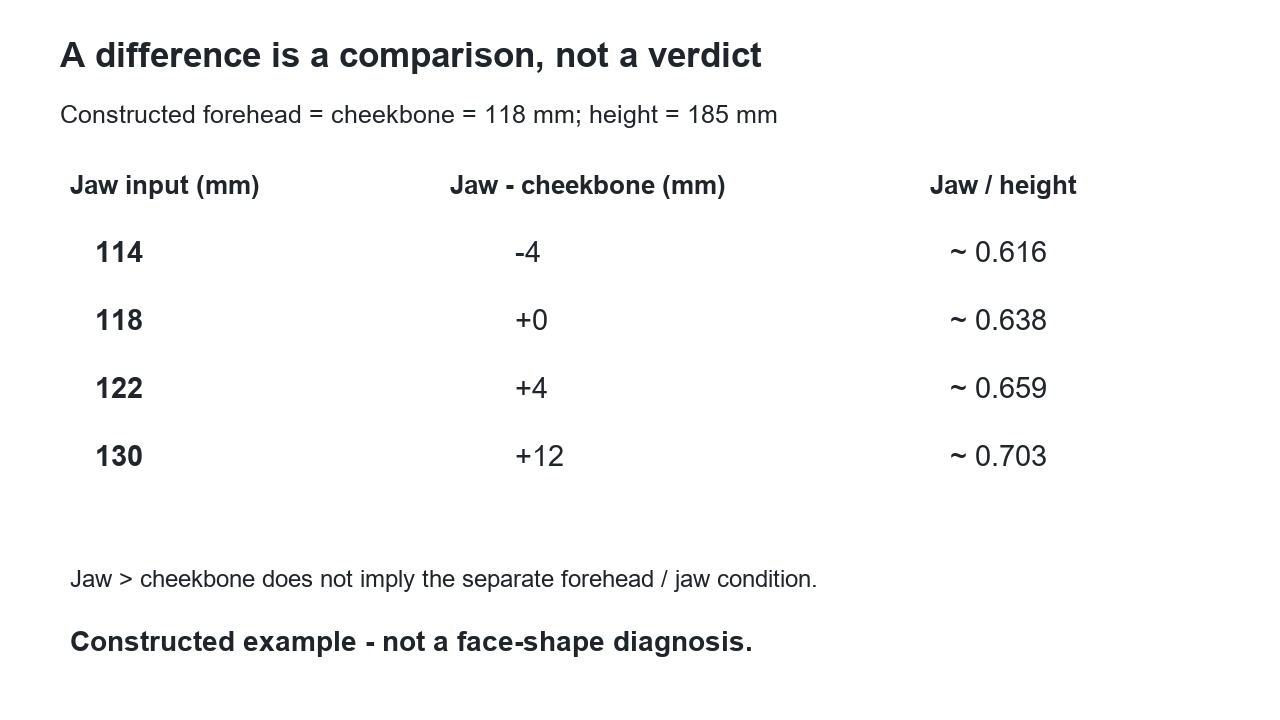
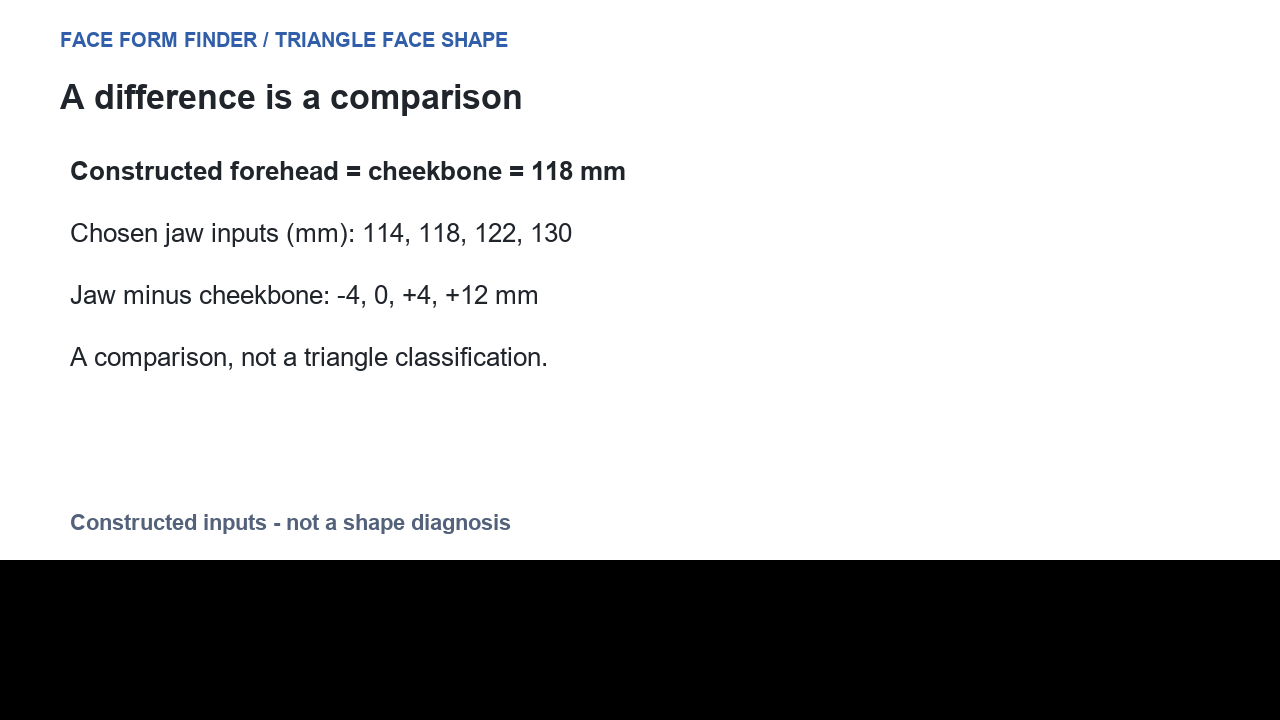
Choose forehead and cheekbone widths of 118 mm and height 185 mm. The jaw inputs below are hypothetical, not a sample, normal range or home-measurement protocol. Only the chosen jaw input changes.
| Jaw (mm) | Jaw minus 118 mm | Jaw / height 185 mm |
|---|---|---|
| 114 | -4 | 0.616216 |
| 118 | 0 | 0.637838 |
| 122 | 4 | 0.659459 |
| 130 | 12 | 0.702703 |
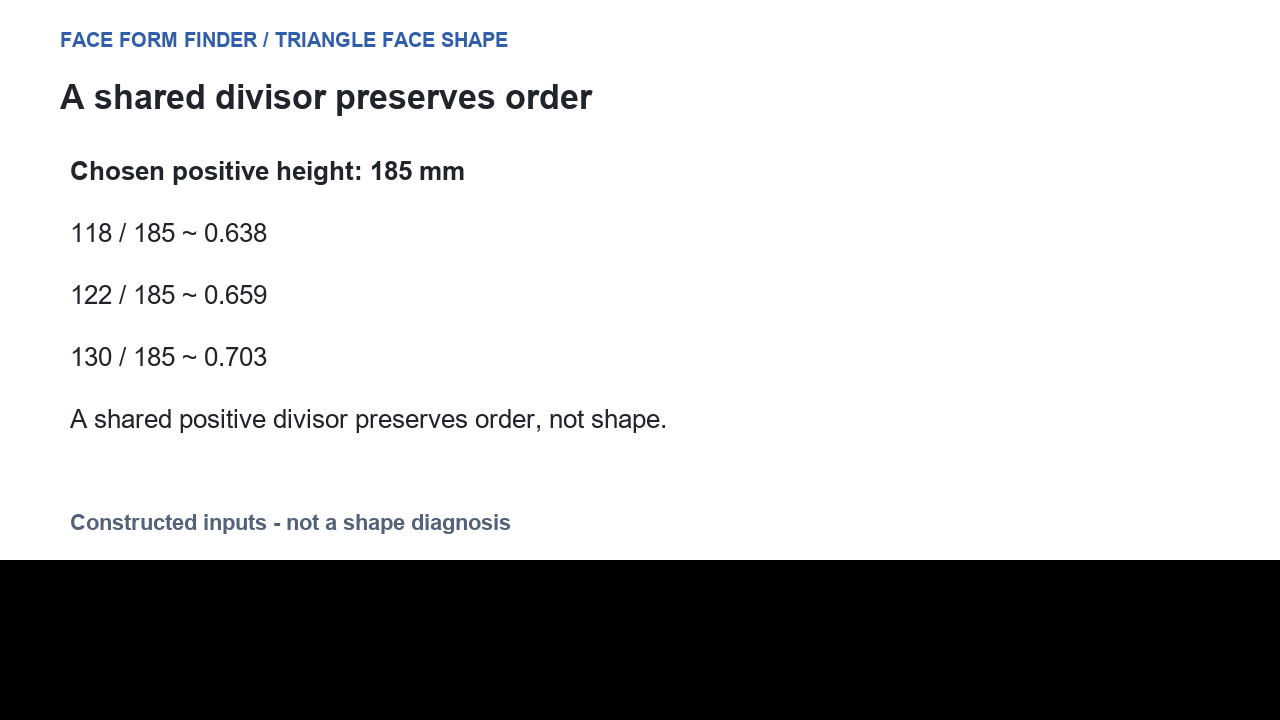
Positive and negative differences identify ordering under these inputs. They do not make the label switch automatically. Dividing widths by the same positive 185 mm denominator preserves their order; it creates no new classification evidence. At 118 mm each input divided by 185 mm is approximately 0.637838.
Two conditions are different
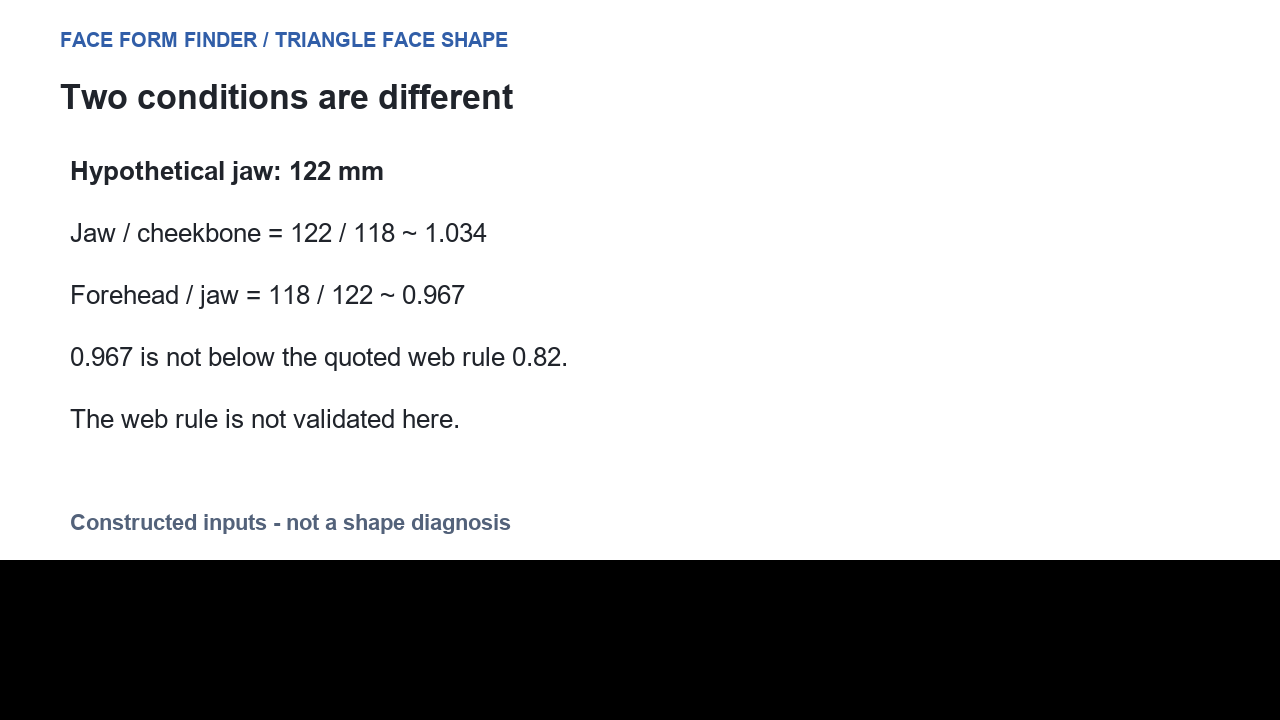
In this calculated example, compare the two ratios using the same chosen forehead and cheekbone widths.
| Jaw (mm) | Jaw / cheekbone 118 | Forehead 118 / jaw | Below 0.82? |
|---|---|---|---|
| 122 | 1.033898 | 0.967213 | No |
| 130 | 1.101695 | 0.907692 | No |
The quoted FaceCalculators webpage gives a forehead-to-jaw condition below 0.82. This review does not establish it as a validated classification standard. For jaw 122 mm, a forehead-to-jaw value below 0.82 would require forehead width below 100.04 mm; our chosen 118 mm does not meet it. Even meeting several web conditions would not validate a diagnosis.
Read percentage denominators carefully. The same webpage describes the jaw as more than 18% wider than the forehead, but that corresponds to forehead/jaw below 1/1.18, approximately 0.847458, rather than 0.82. Conversely, forehead/jaw below 0.82 implies jaw/forehead above 1/0.82, approximately 1.219512. These are not equivalent conditions. No universal rule is selected here.
Under a hypothetical fixed jaw 118 mm, multiplying 0.82 by 118 gives 96.76 mm. A strict condition below 0.82 would require forehead width below 96.76 mm, not a boundary rounded to 96.8 mm. This conditional product does not reveal an anatomical gap between shape categories.
Bounds need assumptions
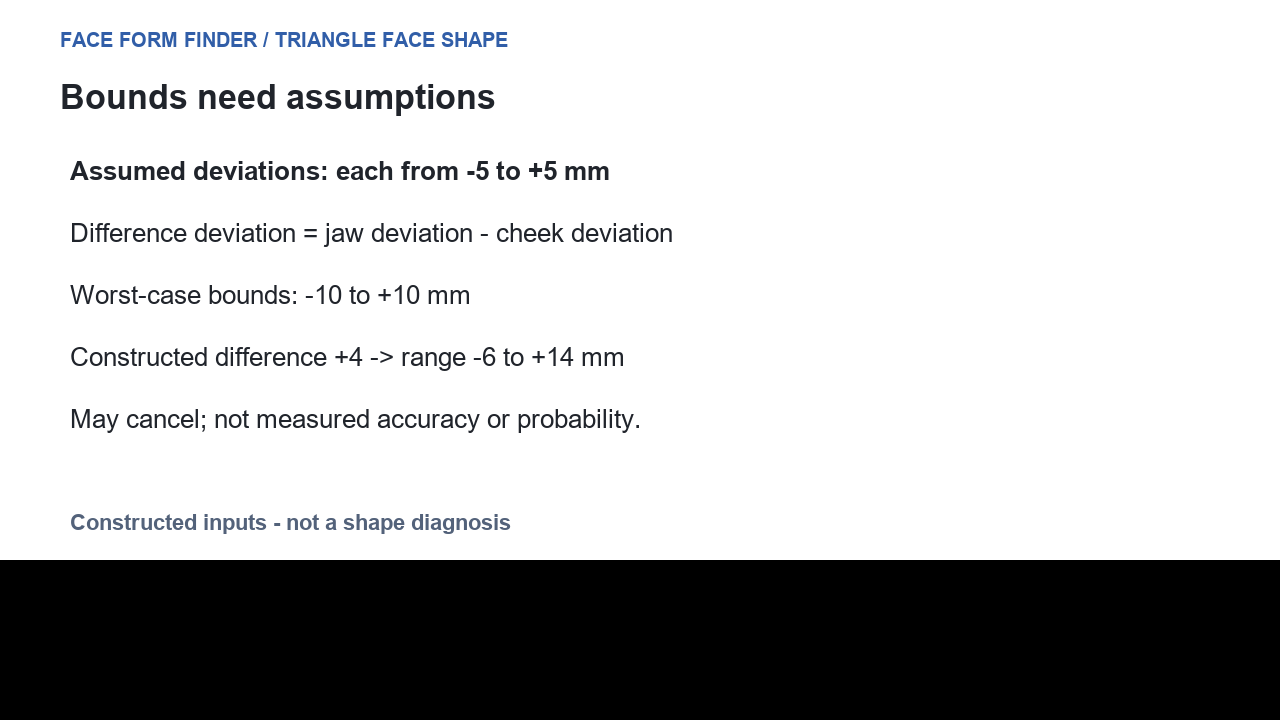
Assume each additive input deviation lies between−5 and+5 mm. These are chosen bounds, not measured repeatability. If the displayed difference is 4 mm, the possible difference under those bounds is 4 plus jaw deviation minus cheekbone deviation.
| Jaw deviation (mm) | Cheekbone deviation (mm) | Deviation of difference (mm) | 4 plus deviation (mm) |
|---|---|---|---|
| -5 | 5 | -10 | -6 |
| 0 | 0 | 0 | 4 |
| 5 | -5 | 10 | 14 |
| 5 | 5 | 0 | 4 |
The deviations may cancel or amplify. Their worst-case difference is bounded by±10 mm under the stated assumptions; errors do not necessarily add in a real measurement. This is not a standard deviation, confidence interval, measured noise floor or diagnostic margin. The conditional ratio 10/185 is approximately 0.054054, with no accuracy claim.
Keep the method defined
Specify both widths, endpoints, units, tools and measurement method before comparing real readings. A straight width and a curved tape path are different distances. This page establishes no wider-side rule, universal averaging benefit or guarantee that observers locate landmarks identically. A jaw angle is not established merely by inspecting a photograph.
The widths on one card
Questions
What is a triangle face shape?
Triangle is a styling term often used for an outline that widens toward the jaw. This page does not establish a universal numeric definition.
How do I know if my face is a triangle?
Do not use these constructed inputs as a self-test. A jaw-versus-cheekbone comparison and a forehead-versus-jaw condition are different statements, with no validated classifier established here.
Is a triangle face the same as a pear face?
Labels and descriptions can vary. No verified bone-angle cutoff separating these terms is established here.
How much wider does my jaw have to be?
A positive difference only says that one defined width is larger. It does not supply a validated classification margin or establish actual measurement accuracy.
Why can pages give different labels?
Inputs, definitions and rules may differ. This example illustrates distinct comparisons, not the usual cause of disagreements across sites.
Related guides
- Square Face Shape — a related outline description and its measurement limitations.
- Round Face Shape — a related outline description and why length endpoints matter.
- Face Shape Chart — the four measurements, and how to check the thirds at home with a soft tape.
- What Is My Face Shape? — the four readings most guides ask you to take, and why one head can read two shapes.
- Jawline Shape — the gonial angle, the bigonial width, and how far the sample spread runs.
- Best Haircut for a Triangle Face — what to do with the width once the reading is taken.
- Bangs for a Triangle Face — the forehead end of the same outline, and the fringe lengths that change it.
The 124-second version
The four panels restate what the tables above do: panel 1 turns a width difference into an ordering rather than a label, panel 2 keeps the jaw ratio separate from the forehead-to-jaw condition, panel 3 puts chosen bounds on an additive deviation, and panel 4 shows that one shared divisor leaves the order unchanged.
If the player does not load, watch the 2:05 version on YouTube: Triangle Face Shape: A Difference, Two Conditions.