FACE FORM FINDER · 5 OCTOBER 2026
Round Face Shape
Four readings, with their limits
| Reading | Limit here |
|---|---|
| Face length / cheekbone width | Requires named endpoints; the quoted web ranges are unvalidated here. |
| Forehead width / jaw width | Relative widths; no independently established round-specific cutoff here. |
| Cheekbone width / mean of forehead and jaw widths | Relative widths; insufficient to establish a round classification. |
| Gonial angle | No independently established round/square threshold here. A visible jaw outline does not verify a bone-angle measurement. |
A constructed example, not a measured person
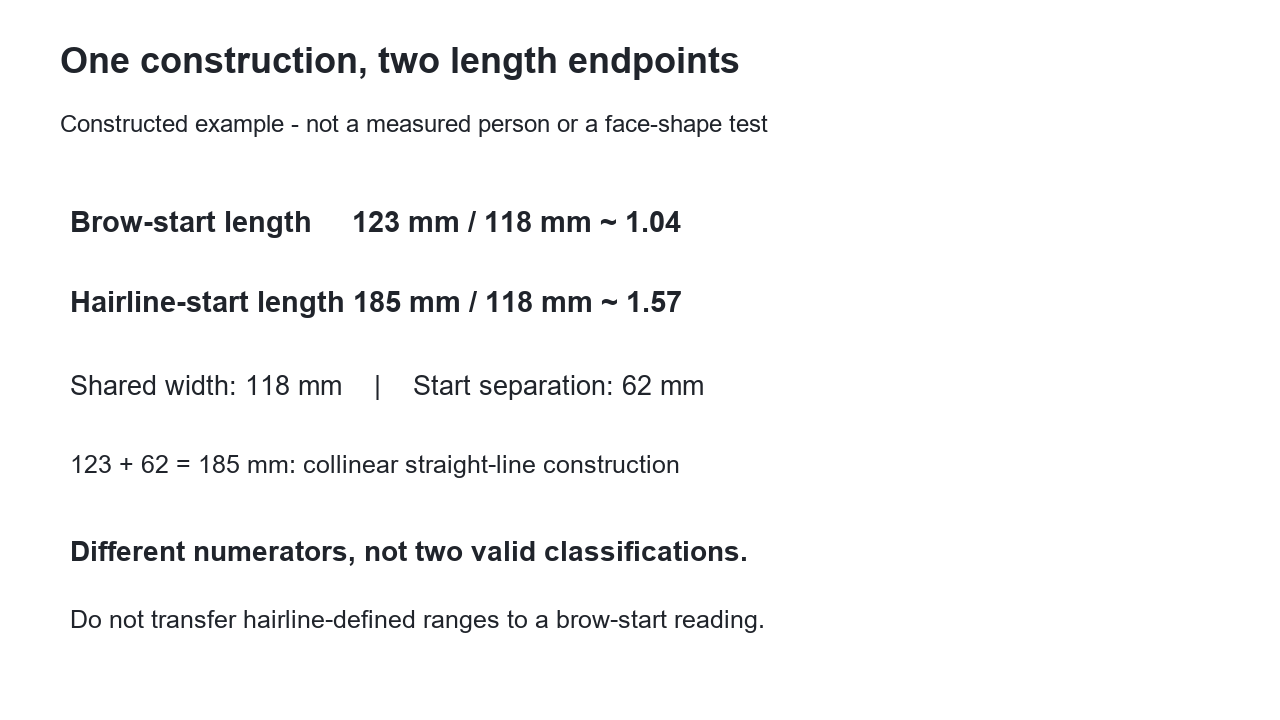
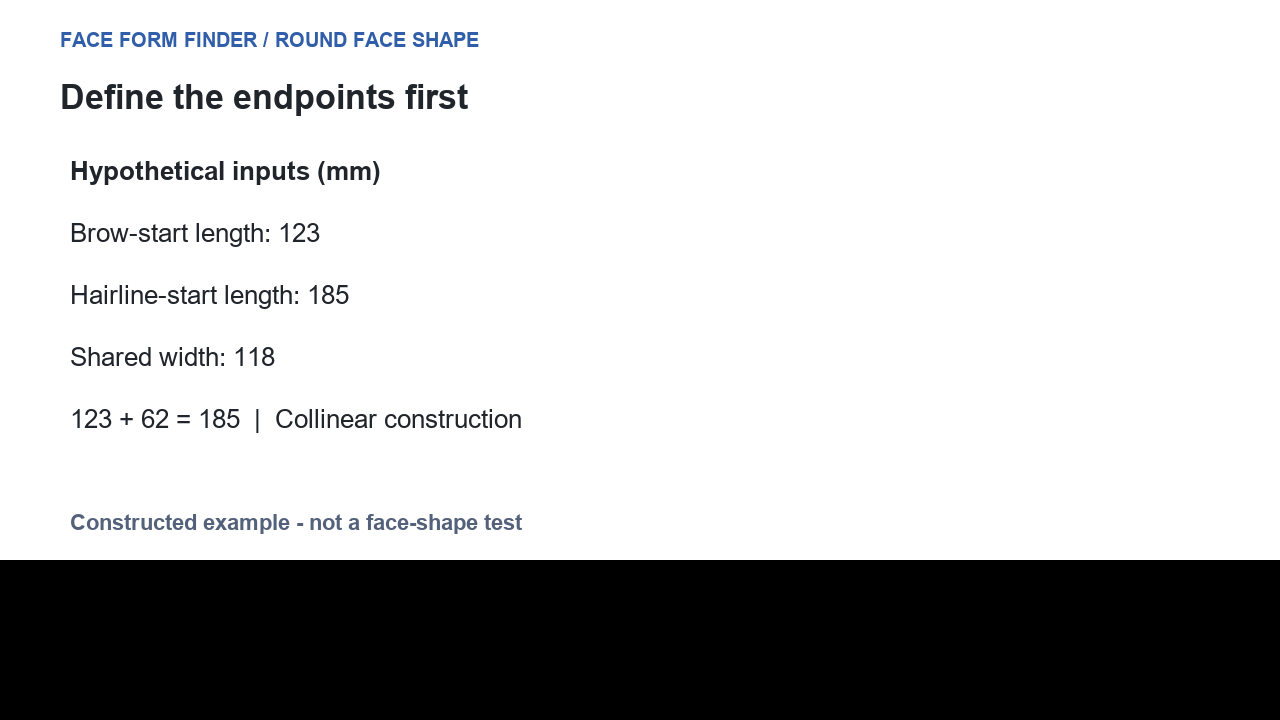
The inputs below are hypothetical straight-line distances, not population averages or tape-over-skin measurements. The two vertical lengths share a chin endpoint and are constructed as collinear: 123 + 62 = 185 mm. They are not a protocol for locating anatomical landmarks on a person.
| Input | mm |
|---|---|
| Brow-start length | 123 |
| Hairline-start length | 185 |
| Start separation | 62 |
| Shared cheekbone width | 118 |
Two divisions, no two verdicts
| Calculation | Ratio, rounded |
|---|---|
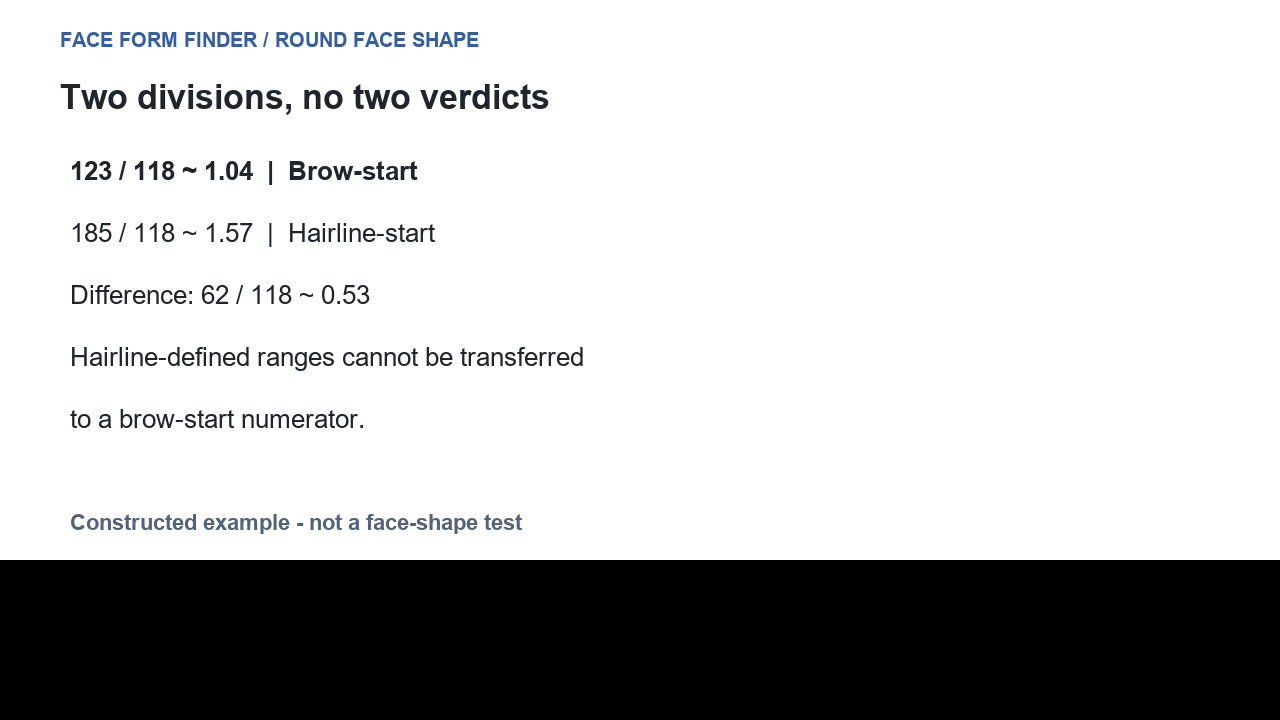
| 123 / 118 | 1.04 |
| 185 / 118 | 1.57 |
| 62 / 118 | 0.53 change |
The unrounded difference is approximately 0.525424. The displayed values are rounded, not exact identities. The quoted FaceCalculators rubric defines R1 from the hairline centre to the chin, so its ranges cannot validate a brow-start reading. Correct division does not validate a classification rule.
Quoted ranges as conditional arithmetic
The FaceCalculators cards list the ranges below. They are one website's rubric, not a validated population standard established by this review. Its round comparison row instead says below 1.15, differing from the card's lower-bound presentation. In this calculated example, multiplying the card bounds by our fixed 118 mm width produces the lengths below; these products are not anatomical requirements.
| Quoted card range | Length product |
|---|---|
| Round: 0.90–1.15 | 106.2–135.7 mm |
| Square: 1.00–1.30 | 118–153.4 mm |
| Oval: 1.40–1.60 | 165.2–188.8 mm |
| Oblong: above 1.60 | above 188.8 mm |
The round-card and square intervals intersect at 1.00–1.15, or 118–135.7 mm under this construction. The overlap does not resolve a shape classification.
Sensitivity is conditional
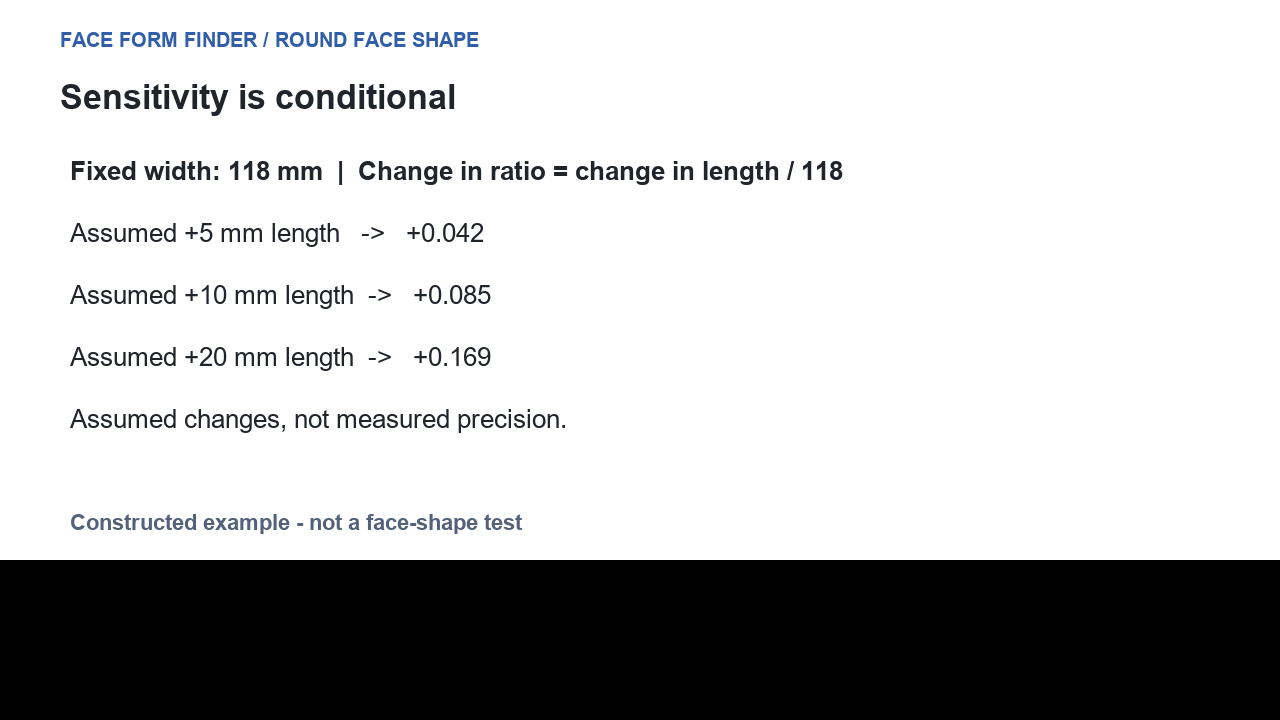
In this constructed example with width fixed, change in ratio = change in length / 118. Assumed length increases of 5, 10 and 20 mm add approximately 0.042, 0.085 and 0.169. The round-card interval's midpoint is 1.025; adding 20 / 118 gives approximately 1.194492. These are assumed changes, not observed errors, precision estimates or diagnostic boundaries.
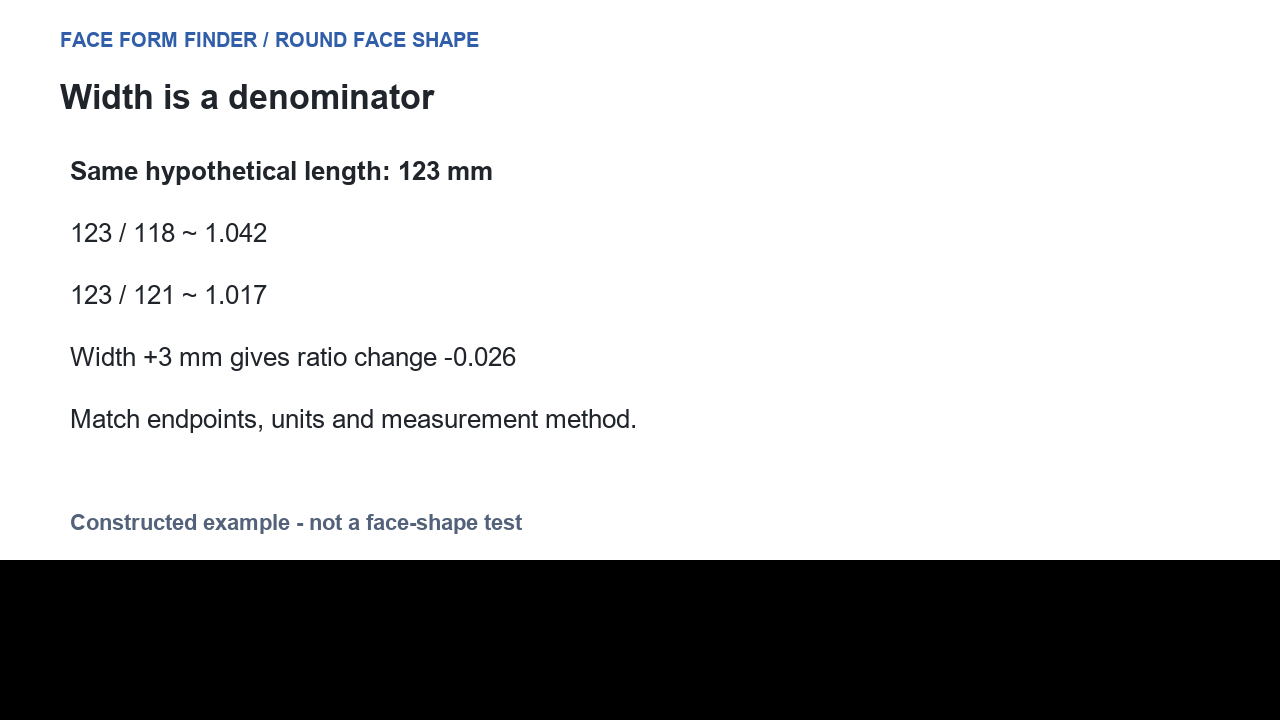
Width is a denominator. At fixed length 123 mm, changing width from 118 to 121 mm changes the ratio from approximately 1.042373 to 1.016529: a decrease of approximately 0.025844, not an increase of 3 / 118. This is not a method for estimating real facial asymmetry. No wider-side selection rule is established here.
Where these calculations stop
Do not compare ratios as if their endpoints and methods were identical when they are not. An unscaled photograph does not provide physical millimetres. The sensitivity examples do not establish a measured noise floor, a universal averaging protocol or a shape diagnosis. Hair should not obscure the chosen landmark; this does not promise that different observers locate it identically.
The two readings on one card
Questions
What is a round face shape?
Round is a styling description commonly used for a relatively rounded outline. This page does not establish a universal numerical definition.
How do I know if my face is round?
Use a clearly stated method and inspect its limitations; the constructed ratios here cannot classify your face. Do not apply hairline-defined ranges to a brow-start measurement.
Where does face length start?
It depends on the named measure. The quoted website defines R1 from hairline centre to chin. Our brow-start example is a different numerator.
Why can the same face get different labels?
Different definitions, inputs or classification rules can produce different outputs. This example demonstrates one mechanism, not the usual cause of disagreements between sites.
Is a round face short?
A ratio describes relative dimensions, not their absolute size; a label alone does not specify a length in millimetres.
Related guides
- Square Face Shape — the other compact ratio, and the corner that separates it from this one.
- Triangle Face Shape — the shape decided by which of the three widths leads.
- Face Shape Chart — the thirds of the face, and how to check them at home with a soft tape.
- What Is My Face Shape? — the four readings most guides ask you to take, and why one head can read two shapes.
- Jawline Shape — the gonial angle, and how far the sample spread runs.
- Midface Ratio — one numerator over several denominators, on a face that does not move.
- Glasses for a Round Face — the frame widths, and the sum worth doing before you order.
The 124-second version
The four panels restate what the tables above do: panel 1 fixes the two endpoints before any division, panel 2 puts the same width under two numerators, panel 3 moves only the endpoints, and panel 4 keeps the width as the denominator.
If the player does not load, watch the 2:05 version on YouTube: Round Face Shape: Two Starts, One Width.