FACE FORM FINDER · 5 OCTOBER 2026
Square Face Shape
What kind of quantity is each reading?
A ratio, a distance and an angle are different quantities. The old category-specific cutoffs are not independently established by this review. No numerical entry below diagnoses a square face.
| Quantity | Inputs or units | Limit here |
|---|---|---|
| Face length / cheekbone width | Two defined lengths, same units | Named endpoints required; no universal square boundary established |
| Jaw width / pupil distance | Two defined transverse distances | Pupil distance is fixed only within our construction |
| Gonial angle | Angle, degrees | No verified square-specific angle threshold here |
| Jaw angle to ear | Distance, named endpoints required | No verified 2 cm classification boundary here |
| Lower-face / cheekbone width | Dimensionless ratio | No verified 85% classification boundary here |
| Jaw width | Distance, mm or cm | No verified adult 9–12 cm range established here |
Constructed inputs, not an adult sample
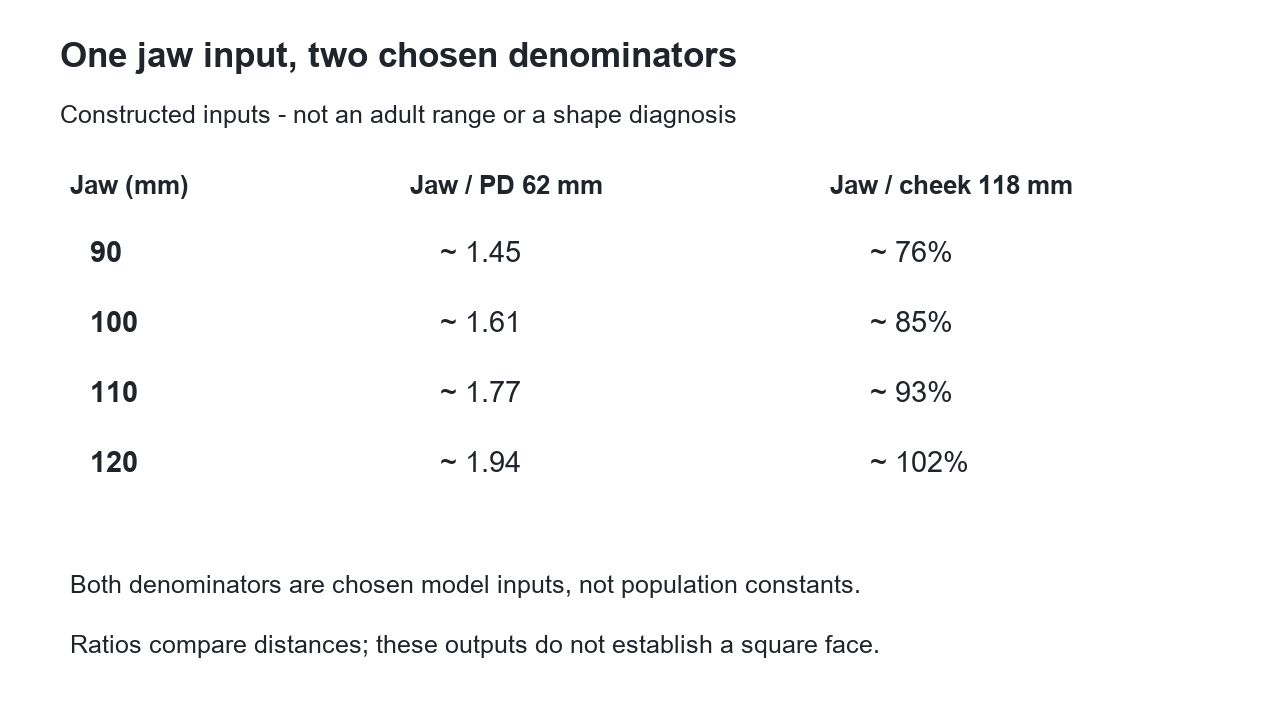
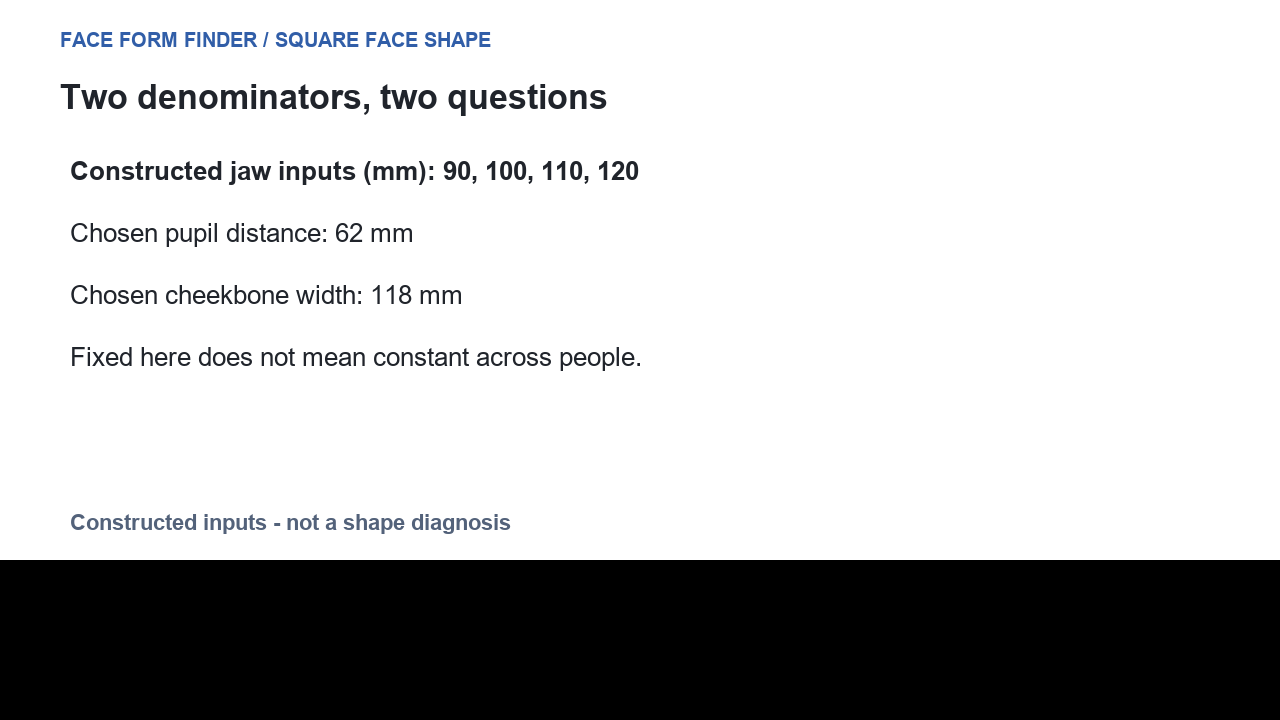
Choose pupil distance 62 mm and cheekbone width 118 mm. The hypothetical jaw inputs are 90, 100, 110 and 120 mm. These are model inputs, not a measured person, a typical adult or a population range. Holding a denominator fixed here does not establish that it is constant across people.
| Hypothetical jaw (mm) | Jaw / 62 mm | Jaw / 118 mm, percent |
|---|---|---|
| 90 | 1.45 | 76% |
| 100 | 1.61 | 85% |
| 110 | 1.77 | 93% |
| 120 | 1.94 | 102% |
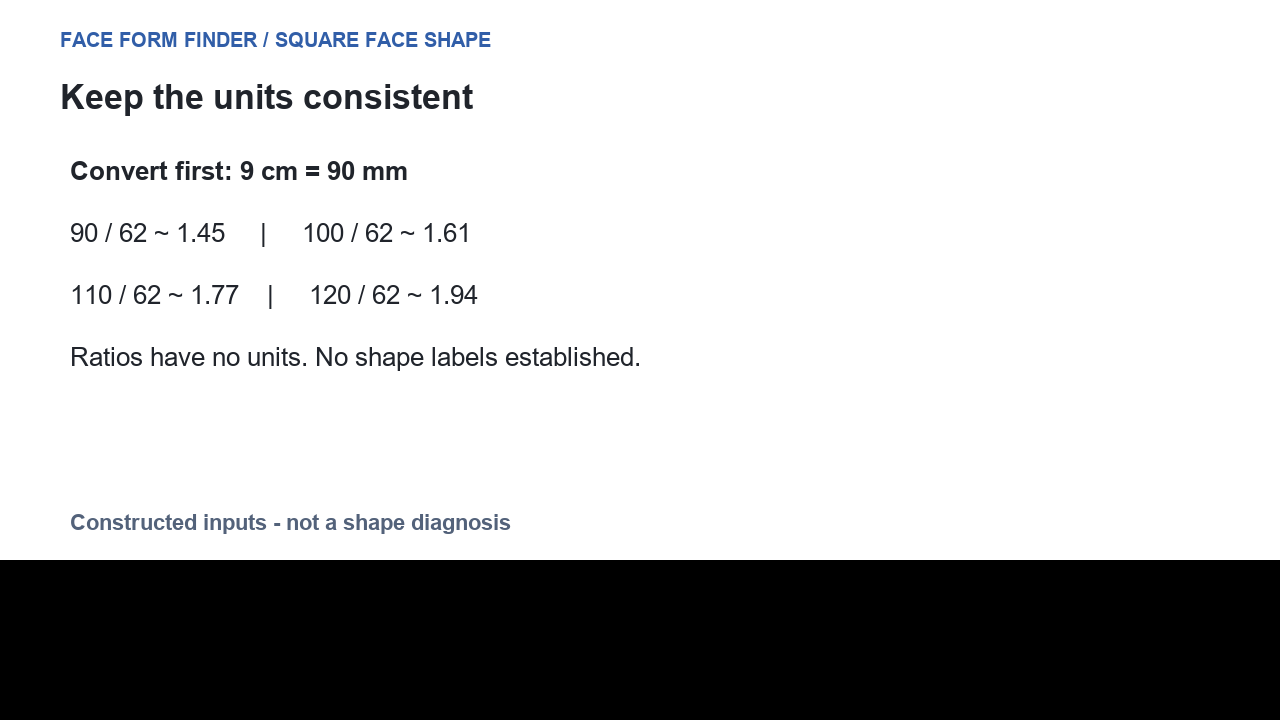
Displayed outputs are rounded. Nine centimetres must first become 90 mm before division by a denominator in millimetres. The ratios themselves have no units. A different denominator answers a different comparison; neither column establishes ordinary, wide or square.
Changing a denominator
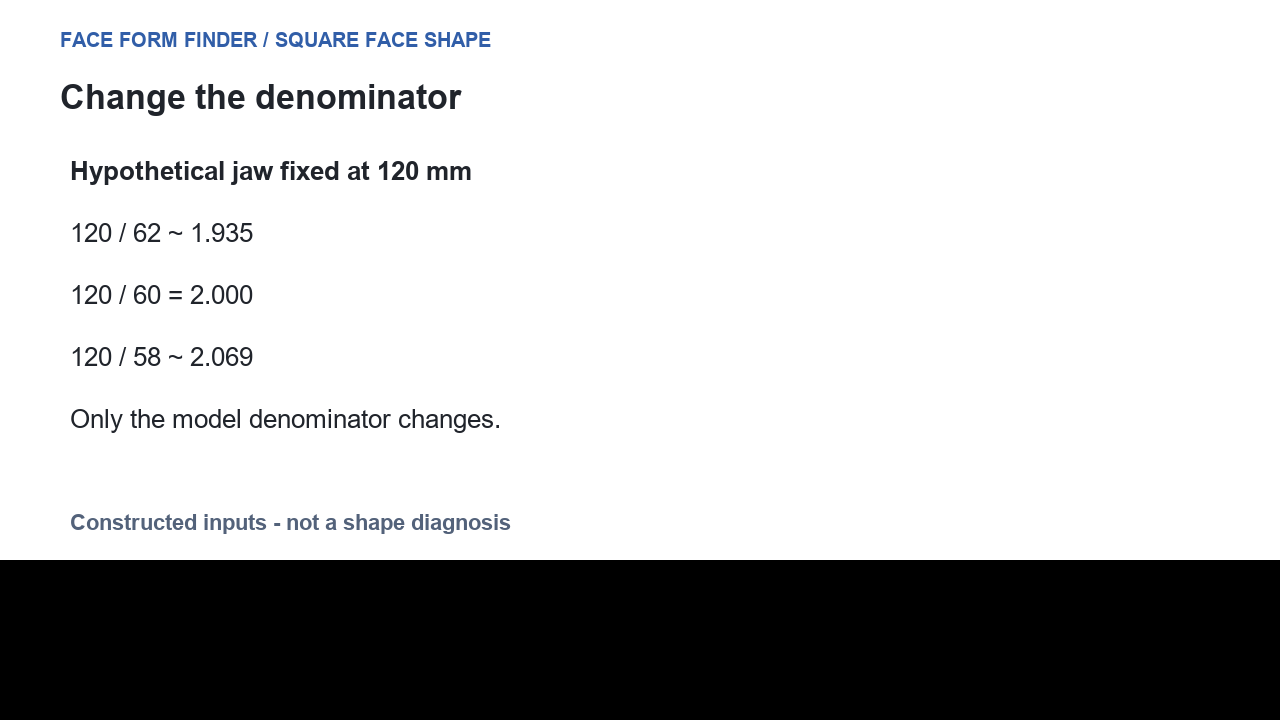
In this calculated example, keep jaw width at 120 mm and change the chosen pupil distance.
| Chosen pupil distance (mm) | 120 / chosen distance |
|---|---|
| 62 | approximately 1.935 |
| 60 | 2.000 exactly |
| 58 | approximately 2.069 |
Only the chosen denominator changes in this model. This does not show a real person's pupil distance changing or crossing a validated shape boundary. If an arbitrary target ratio were 2, the relation would be jaw = 2 × pupil distance; strictly above 2 requires jaw > 2 × pupil distance. The equality is arithmetic, not a wide-jaw test.
Assumptions are not accuracy
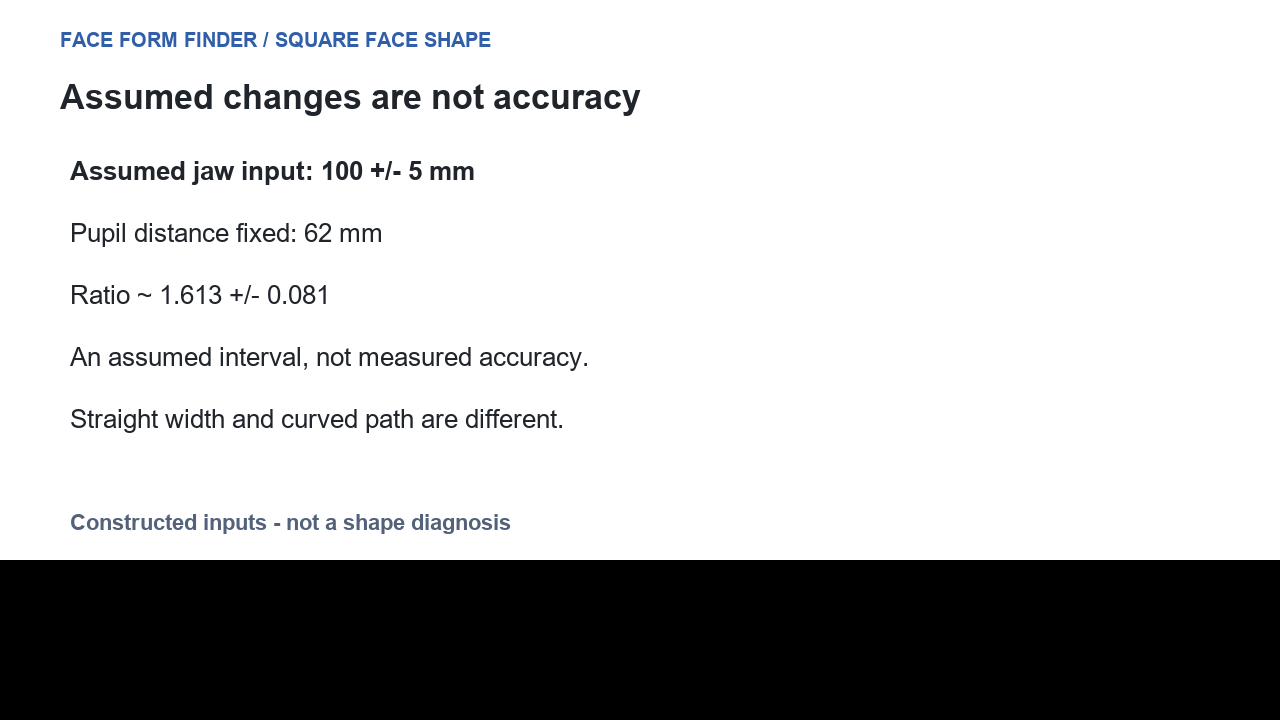
In this hypothetical model the jaw input is 100 ± 5 mm while pupil distance remains 62 mm.
| Jaw input (mm) | Calculated ratio |
|---|---|
| 95 | 1.532258 |
| 100 | 1.612903 |
| 105 | 1.693548 |
The centre is approximately 1.612903 and the assumed half-width is 5 / 62, approximately 0.080645. If the denominator also varies, this numerator-only calculation is incomplete. No real measurement precision or universal averaging benefit is established here.
Keep the measurement method defined
Specify landmarks, units, tool and method before comparing measurements. A straight transverse width and a tape path curving under a jaw are different distances. This page gives no validated home-measurement protocol or rule to take a wider side. Bilateral measurements cannot silently replace a defined full-width measurement.
Size, proportion and fitting
A distance records size; a ratio compares two distances. Neither alone guarantees that glasses or clothing will fit. The former 3 mm and 5 mm comfort rules are not established here. For existing frame listings, see the square-face glasses page; this page does not supply a self-fitting or optical-comfort threshold.
One jaw on two yardsticks
Questions
What is a square face shape?
Square is a styling description commonly used for an angular outline. This page does not establish a universal numerical diagnosis.
How do I measure my jaw width?
First specify the landmarks and whether the method records a straight distance or a curved path. This page does not establish an interchangeable soft-tape protocol.
What is a normal jaw width?
The chosen 90–120 mm inputs here are not a normal range. A population claim needs its own sample, landmarks and method.
Is 2.0 a wide jaw?
Not on the evidence established here. A ratio of 2 only says that the numerator is twice the denominator under the stated definitions.
Why can sites give different readings?
Definitions, inputs and rules can differ; this example demonstrates denominator dependence, not the usual cause of disagreements.
Can a square face be small?
A proportion does not determine absolute size. Scaling both inputs by the same factor leaves their ratio unchanged, without establishing a shape label.
Related guides
- Round Face Shape — the related shape label and why endpoint definitions matter.
- Triangle Face Shape — a related outline description and its measurement definitions.
- Face Shape Chart — the thirds of the face, and how to check them at home with a soft tape.
- What Is My Face Shape? — the four readings most guides ask you to take, and why one head can read two shapes.
- Facial Width to Height Ratio — what happens to a ratio when the top line moves and the face does not.
- Midface Ratio — the same denominator as the jaw reading here, used on a different numerator.
- Jawline Shape — the three jaw readings, including the gonial angle, and how far the sample spread runs.
The 123-second version
The four panels take the same constructed inputs in order: panel 1 puts one jaw under two denominators, panel 2 turns centimetres into millimetres before dividing, panel 3 moves only the chosen pupil distance, and panel 4 shows an assumed interval rather than a measured precision.
If the player does not load, watch the 2:04 version on YouTube: Square Face Shape: One Jaw, Two Yardsticks.