FACE FORM FINDER · 8 OCTOBER 2026
Pupillary Distance
The figures in the two tables below are worked out from that one rule, and the arithmetic is left visible so it can be repeated. What follows is not another way to measure your pupillary distance; it is what a wrong one costs once the lens is made.
Why the offset becomes a prism
A lens is ground with an optical centre, the point where light passes through without bending. For the lens to correct your vision, that point has to sit over your pupil, and your pupillary distance is the number that places it there.
When the number is wrong, the optical centre lands off the pupil by exactly the error. A lens read away from its optical centre bends light the way a prism does, and the size of that bend is the offset multiplied by the power of the lens.
Which lens power belongs in the calculation?
The tables use the magnitude of the lens power in the direction of the offset. For a spherical lens, the power is the same in its meridians. For a lens with cylinder, the principal meridian along the cylinder axis has the sphere power; the perpendicular principal meridian has sphere plus cylinder. The next example uses only those principal directions. It does not calculate oblique-axis vector prism.
Take two hypothetical prescriptions with sphere -2.00 D and cylinder -2.00 D. With axis 180 degrees, the horizontal principal power is -2.00 D. With axis 90 degrees, the horizontal principal power is -2.00 + (-2.00) = -4.00 D. A 1 mm horizontal offset gives calculated prism magnitudes of 0.1 x 2 = 0.2 and 0.1 x 4 = 0.4 prism dioptres, respectively. The sphere and cylinder entries match, but their axes select different horizontal powers. These are constructed calculations, not results measured on glasses or a person.
For the axis-180 example, using the spherical equivalent -2.00 + (-2.00 / 2) = -3.00 D would produce 0.3 rather than the horizontal-principal result 0.2. Do not substitute that averaged power for an identified directional power. These examples report magnitudes only, not prism base directions or symptoms. For an oblique axis or an unknown prescription, this simple input check is incomplete.
In both tables, the offset is the displacement at one lens between its optical centre and the line of sight. It is not automatically the error in the total binocular PD: assigning a total error equally to the two sides requires the separate symmetry assumption stated below.
The error, at each lens power
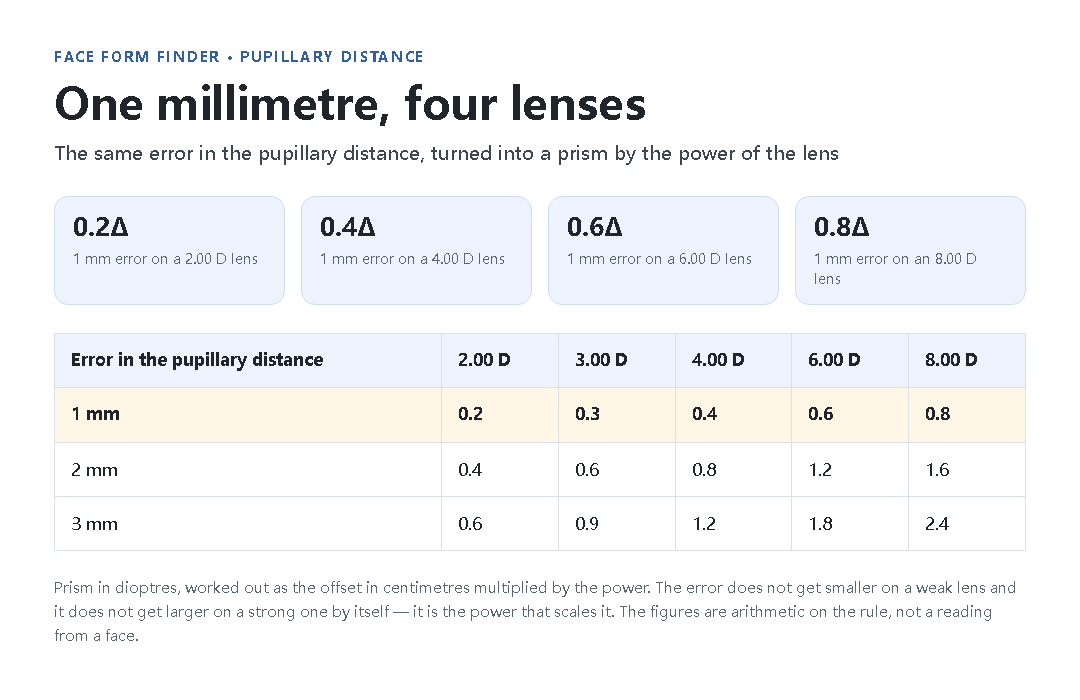
Read down the left column for the error and across the top for the power. Each cell is the prism that error produces at that power, in prism dioptres.
| Error in the pupillary distance | 2.00 D | 3.00 D | 4.00 D | 6.00 D | 8.00 D |
|---|---|---|---|---|---|
| 1 mm | 0.2 | 0.3 | 0.4 | 0.6 | 0.8 |
| 2 mm | 0.4 | 0.6 | 0.8 | 1.2 | 1.6 |
| 3 mm | 0.6 | 0.9 | 1.2 | 1.8 | 2.4 |
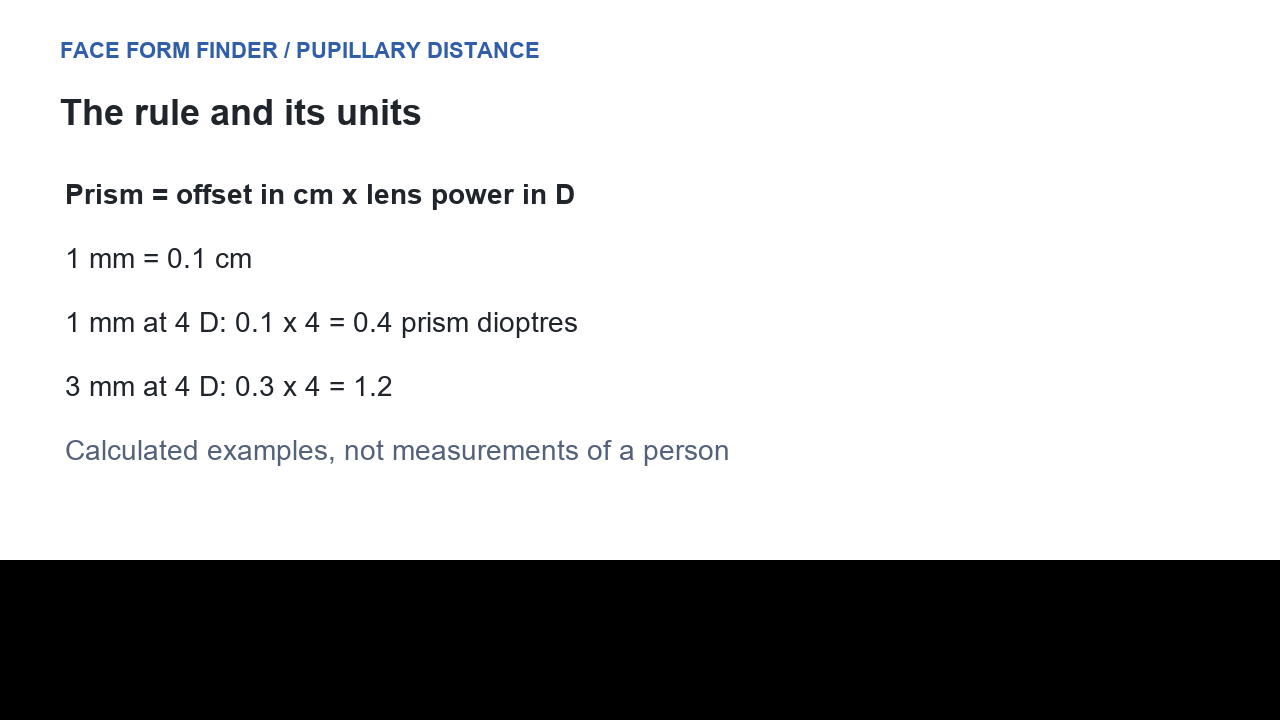
The whole table was worked out on 2026-10-08: the error in centimetres multiplied by the power in dioptres, so 1 mm at 8.00 D is 0.1 against 8, which is 0.8.
The error that reaches half a prism dioptre
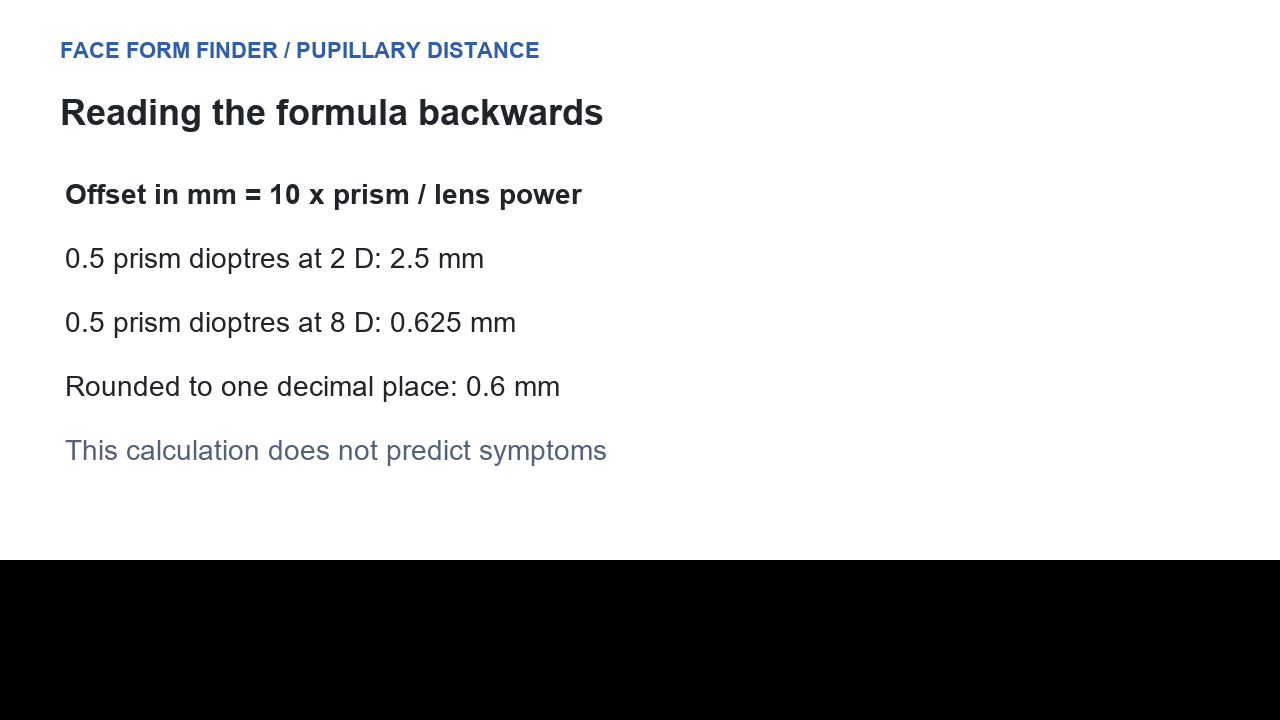
Turned around, the same rule gives the error that produces a given prism. Half a prism dioptre arrives at 2.5 mm on a 2.00 D lens, and at 0.6 mm on an 8.00 D lens. The stronger the lens, the smaller the error that gets there.
| Prism | 2.00 D | 3.00 D | 4.00 D | 6.00 D | 8.00 D |
|---|---|---|---|---|---|
| 0.5 prism dioptres | 2.5 mm | 1.7 mm | 1.25 mm | 0.8 mm | 0.6 mm |
| 1 prism dioptre | 5.0 mm | 3.3 mm | 2.5 mm | 1.7 mm | 1.25 mm |
This table was worked out on 2026-10-08 by dividing ten times the prism by the power, which is the same rule read backwards.
Where the line sits
Here, the line marks the 3.00 D calculation: a 1 mm offset gives 0.1 x 3.00 = 0.3 prism dioptres. This is an arithmetic example, not a noticeability threshold. The first table calculates prism as offset in centimetres times lens power. The second solves for offset in millimetres as ten times prism divided by lens power. Their output units differ; neither table establishes a symptom threshold.
Two numbers, two offsets
A single pupillary distance records the total separation. That total alone does not specify how an error is distributed between the two sides; equal offsets require an explicit symmetry assumption.
A dual pupillary distance is two numbers, one for each side. An error in a dual reading can differ between the two sides, and when it does, the two lenses carry prisms of different sizes. The formula calculates each optical effect separately; it does not establish how either eye will respond.
The distance figure on a near pair
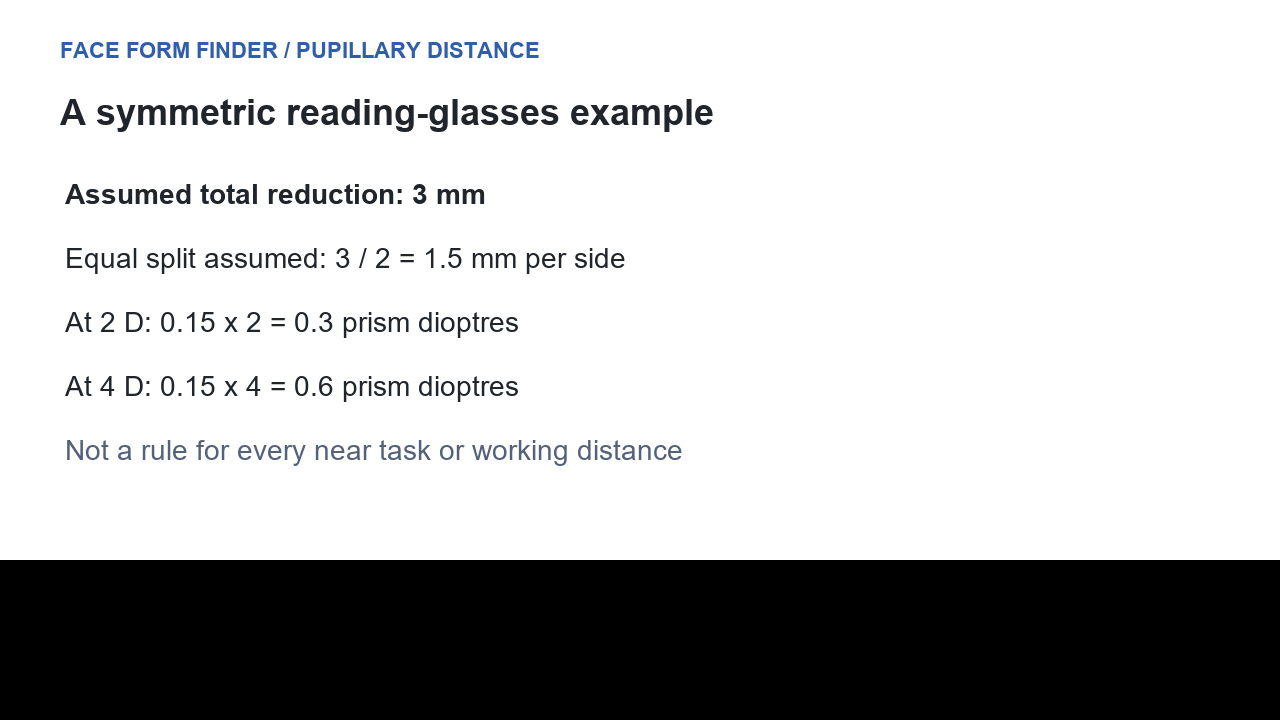
A single pupillary distance spans the pair, so 3 mm across the two is 1.5 mm at each lens. For this reading-glasses calculation, assume the total near figure is 3 mm less than the distance figure and divide that change equally: 3 / 2 = 1.5 mm per side. This is a symmetric example, not a universal rule across working distances or a measurement of either eye.
Ordered to the distance figure instead, a near pair carries that 1.5 mm as an offset at each lens, and through the same rule it becomes 0.3 prism dioptres at 2.00 D and 0.6 at 4.00 D. This paragraph is a model of the arithmetic, not a reading from anyone's glasses, and it assumes the two sides take the same share of the change.
What the error feels like
The computed prism alone cannot identify the cause of discomfort, predict symptoms or diagnose a fitting problem. These tables contain calculated optical effects rather than physiological measurements.
Both tables, the rule behind them, the two offsets a dual reading can carry, and the near-pair model, as a CSV.
One millimetre, four lenses
Questions
What is pupillary distance?
Pupillary distance is the gap between the centres of your two pupils, in millimetres. It is the number that places the optical centre of each lens over the pupil, and the same measurement is also called interpupillary distance. The two names describe one distance.
Does a small error in pupillary distance matter?
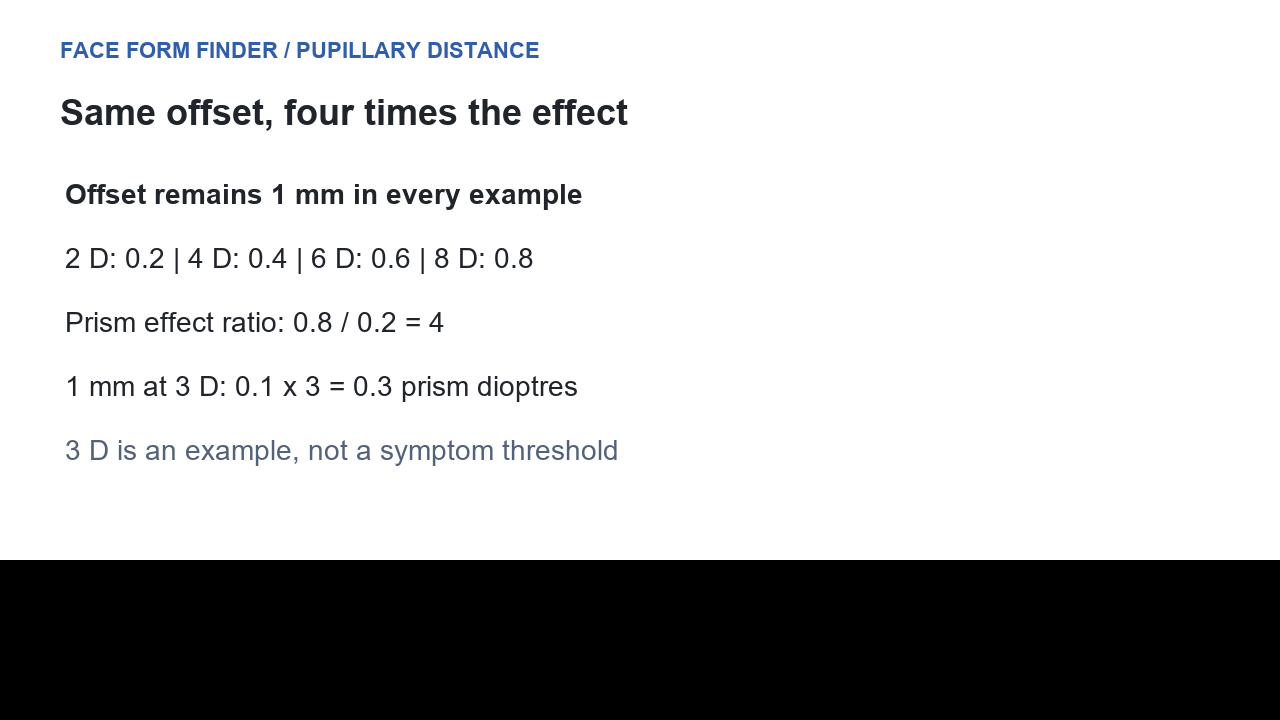
It matters in proportion to the power of the lens. One millimetre is 0.2 prism dioptres at 2.00 D and 0.8 at 8.00 D, so the calculated prism effect is four times as large: 0.8 / 0.2 = 4. The offset remains 1 mm in both cases. That four-times figure is worked out from the rule above rather than measured on a face. This comparison does not establish whether either effect will be noticeable.
What happens if the pupillary distance is wrong on my glasses?
A decentration at a powered lens can induce prism. Calculate each side from its offset and lens power; that number alone cannot predict discomfort or establish its cause.
Is a single or a dual pupillary distance better?
They record different things. A single figure spans the pair but does not determine each side separately; a dual figure records each side, so an error can differ between the two. A dual reading carries more information, and it is also the reading that can go uneven.
Can I use my distance pupillary distance for reading glasses?
This page uses a 3 mm total reduction as a reading-glasses example, not a universal near-PD rule. Under the symmetric assumption, each offset is 1.5 mm and 0.15 cm x 2.00 D = 0.3 prism dioptres. The appropriate near reading depends on the actual task and fitting.
Related guides
- Eye Shape Chart — the pupil-centre distance as one of seven readings of the eye opening.
- Glasses for Round Face — the frame measurements that decide where the lens centre sits on the face.
- Face Shape Chart — the readings that build a face shape from the brow ridge down.
- Midface Ratio — what happens to a reading when the same face is measured to two different end points.
- Face Symmetry Test — the left-right reading of the same photograph.
- Philtrum Length — another short distance on the same face, and the end point that decides it.
The 106-second version
If the player does not load, watch it on YouTube: Pupillary Distance: Same Offset, Different Prism Effects.