FACE FORM FINDER · 6 OCTOBER 2026
Face Symmetry Test
So the useful question is not whether a difference is there. It is how much of the difference the camera is entitled to. The tables below put that share in millimetres, on a face whose two sides are equal by construction, so that anything a test reports has to come from somewhere other than the face.
One number, two differences
A symmetry score is built by reflecting each left-hand landmark across a fitted midline and measuring how far it lands from its right-hand partner. That residual is real arithmetic, and it is arithmetic on a photograph. Two things go into it that have nothing to do with the face: where the camera stood when the photo was taken, and how well the landmarks could be found at all. The rest of this page is about the first of those, because that part can be given a figure.
| Distance | mm |
|---|---|
| Head, front to back | 190 |
| Half of that — the lever arm on each side of the turn axis | 95 |
| Face width, cheekbone to cheekbone | 118 |
| Face height, hairline midpoint to chin | 185 |
These are a defined reference, not a person. A real head will not sit on these numbers, and the point of fixing them is that the arithmetic can then be checked rather than taken on faith.
The four pairs, on a face that is level by construction
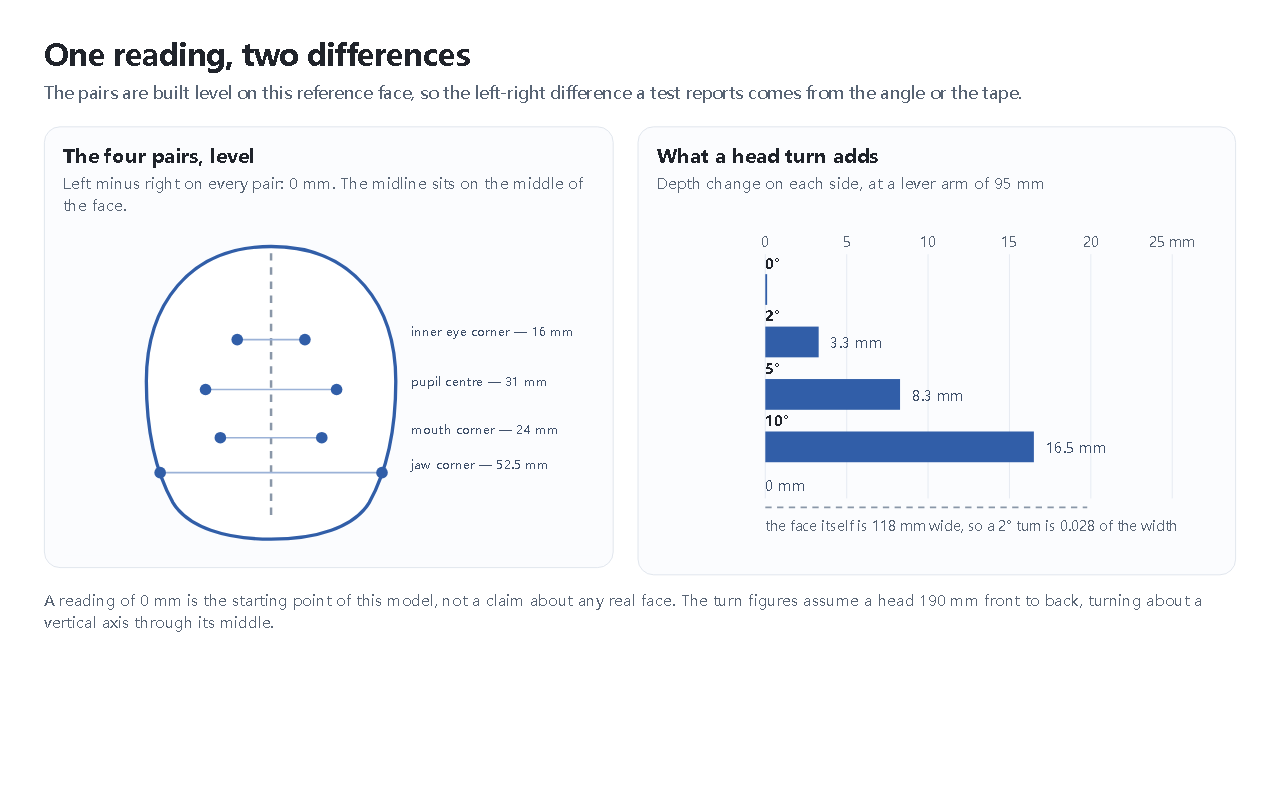
A landmark test compares pairs. The four below are the pairs a front-facing photo can see, and on this face each pair is built to the same distance on both sides. That is deliberate: it means the left-minus-right column starts at zero, and stays at zero until something other than the face moves it.
| Pair | From the midline, each side | Left reading | Right reading | Left minus right |
|---|---|---|---|---|
| Inner eye corner | 16 mm | 16 mm | 16 mm | 0 |
| Pupil centre | 31 mm | 31 mm | 31 mm | 0 |
| Mouth corner | 24 mm | 24 mm | 24 mm | 0 |
| Jaw corner | 52.5 mm | 52.5 mm | 52.5 mm | 0 |
The camera term, written in millimetres
When a head turns, it turns about a vertical axis roughly through its middle. One side comes toward the lens and the other recedes, and the distance each side travels is the lever arm multiplied by the sine of the turn. At small angles the sine is close to the angle itself, which is what makes a two- or three-degree turn easy to dismiss and easy to photograph.
| Head turn | One side closer, the other further | As a share of the 118 mm face width |
|---|---|---|
| 0° | 0 mm | 0 |
| 2° | 3.3 mm | 0.028 |
| 5° | 8.3 mm | 0.070 |
| 10° | 16.5 mm | 0.140 |
The column that matters is the middle one, because depth is what a flat photo turns into apparent width. The nearer cheek is projected a little larger and the further one a little smaller, and the midline the scorer fits ends up sitting off centre for reasons that were never on the face. Two degrees is not a pose. It is the difference between facing the lens and almost facing it, and it is worth 3.3 mm before anything else is counted.
The same arithmetic runs the other way and is more useful in practice. Take the difference a test reports and ask how big a turn would have produced it with the face left alone.
| Reported left-right difference | Turn that produces it on its own |
|---|---|
| 1 mm | 0.6° |
| 2 mm | 1.2° |
| 5 mm | 3.0° |
| 8.3 mm | 5.0° |
| 16.5 mm | 10.0° |
Do the test in three passes
Make a clean baseline
Use the rear camera when you can. Put the lens at eye level, step back, face it squarely, relax the expression, and pull hair off the outline. Use even front light, not a window on one side.
Compare only pairs
Look at paired features: eye level, brow height, nose position, mouth corners, and the broad outline at the jaw. Do not turn one feature into an overall verdict about attractiveness.
Retake before deciding
Take a second photo at the same distance, height and light. Ask one narrow question: does the same left-right difference appear again, at the same size?
The second photo is the test. A single image cannot separate the face from the pose, because both are in the same set of numbers. A repeat at a matched distance can, and it costs one more press of the shutter.
Where the reading stops
The fixed head, the four level pairs, the camera term for turns up to ten degrees, the turn each difference implies, and the stop rules, as a CSV.
The same face, turned
Watch the photo repeat check
Prefer YouTube? Open the video in YouTube.
Questions
How do I test my face symmetry at home?
Take two straight-on, neutral photos at eye level under even light, from the same spot. In each photo, compare matched features on either side of the midline. Treat a difference as a repeatable pattern only when it appears in both captures at about the same size.
What is a good face symmetry score?
There is no universal figure. A score reflects one tool's landmarks, midline and calculation in one photo, and the tools do not share a scale. It is more useful for comparing your own matched photos than for ranking yourself against anyone else.
Can a small head turn really change the result?
Yes, and the size of the change can be worked out. On a head about 190 mm front to back, a two-degree turn moves one side 3.3 mm closer to the lens and the other 3.3 mm further away, which the photo records as an apparent width difference. Five degrees is worth about 8.3 mm, and ten degrees about 16.5 mm.
Why do two apps give me different symmetry scores?
Because they compare different pairs. One may score the eyes, brows, nose, mouth and outline; another may weight them differently or fit its midline from a different set of anchors. The percentages are not interchangeable, and neither is a percentile.
Can a face symmetry test diagnose anything?
No. It compares visible positions in a photograph. A change that is new, one-sided, painful, or that affects speech, chewing or the eye needs a clinician, not a landmark score.
Related guides
- Face Shape Chart — the four measurements, and how to take them at home with a soft tape.
- Golden Ratio Face — what a proportion score does with the same landmarks on the same photo.
- Midface Ratio — one face read against six different divisors, and why the divisor decides the number.
- Jawline Shape — the gonial angle and the bigonial width, the two readings the outline pairs stand in for.
- Face Analyzer — what a tool can return about a photo, and what it cannot.
- What Is My Face Shape? — the four readings most guides ask for, and why one head can read two shapes.