Philtrum Length
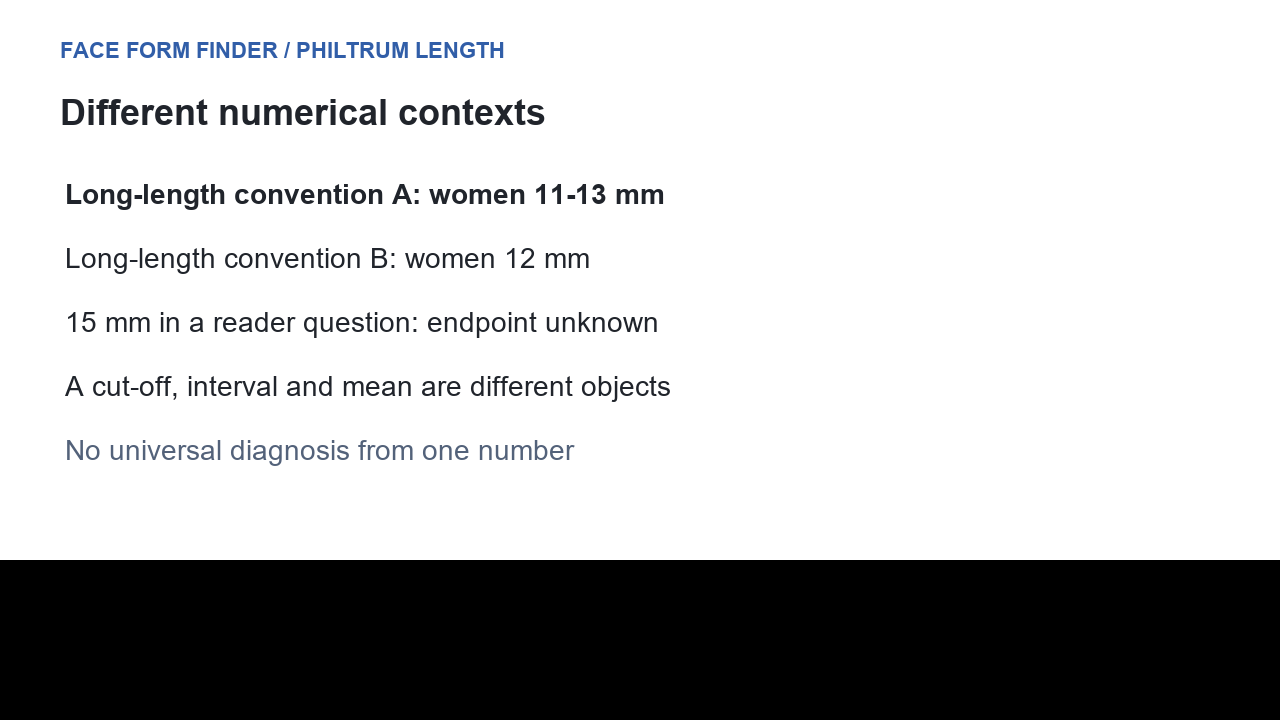
Compare philtrum lengths only after identifying the upper and lower landmarks and the kind of number being used. A cut-off, a reference interval, a group mean and an individual's self-reported result answer different questions. The numerical differences below do not prove that two endpoints on one person's face are a fixed distance apart.
Different numerical contexts
Compiled October 12, 2026. These labels distinguish the recorded contexts; the figures are printed values, not measurements taken on this page.
| Page | The figure it prints | The span it runs between |
|---|---|---|
| Cadogan Clinic | 11-13 mm women; 13-15 mm men | Suggested long-length convention; nose base to upper lip |
| wikiHow | 12 mm women; 15 mm men | A separate long-length convention; nose base to upper lip |
| Orofacial Myology | 15 mm | A questioner's reference value; lower landmark not supplied. Not a confirmed clinical cut-off |
| Onlif Clinic | 11-18 mm women; 13-22 mm men; mean 25.7 mm among 76 patients | Reference intervals and a clinic-specific sample mean; these are not interchangeable |
| QOVES | 20 +/- 2 mm women; 22 +/- 2 mm men | Group averages described as mid-philtral height; endpoint labels conflict within the description, so the exact span is unresolved |
The five figures above were read from the front page of results for this term on 2026-10-08.
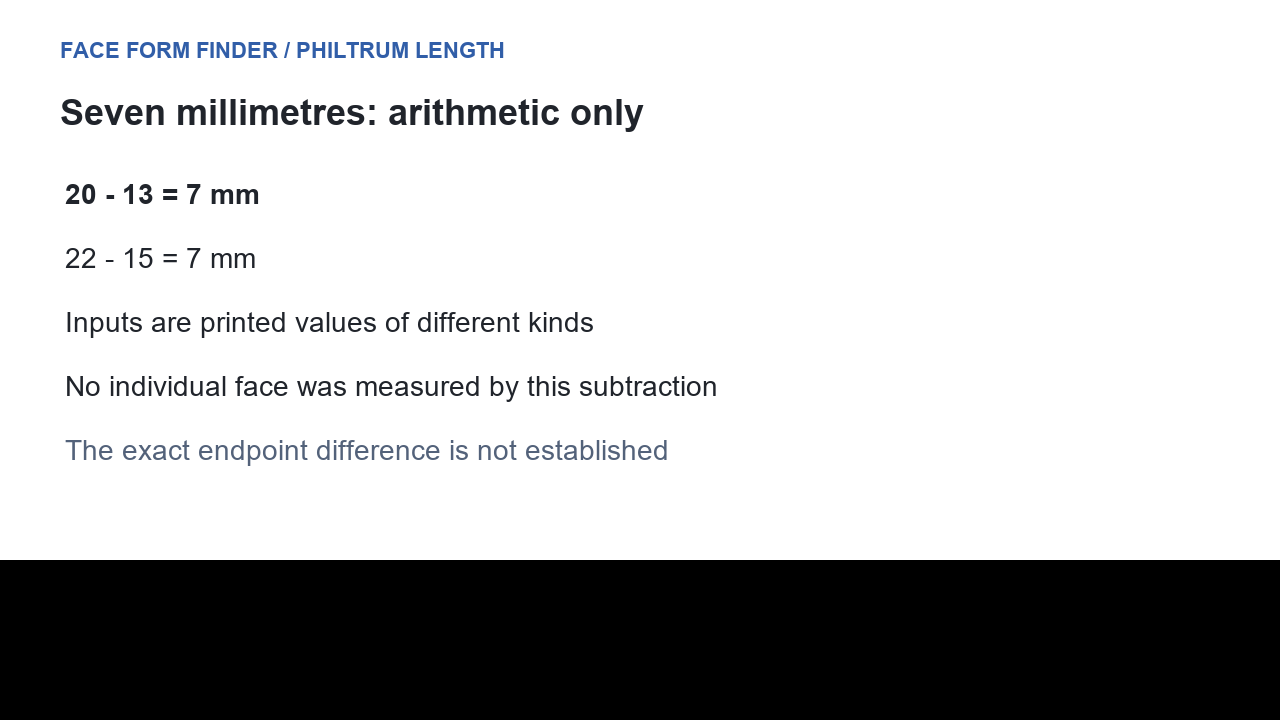
Arithmetic does not resolve the endpoint
20 - 13 = 7 mm and 22 - 15 = 7 mm. These are differences between printed values of different kinds. They are not measurements of a vermilion-to-mouth-closure strip, evidence that two records described the same individual, or proof that different landmarks caused the discrepancy.
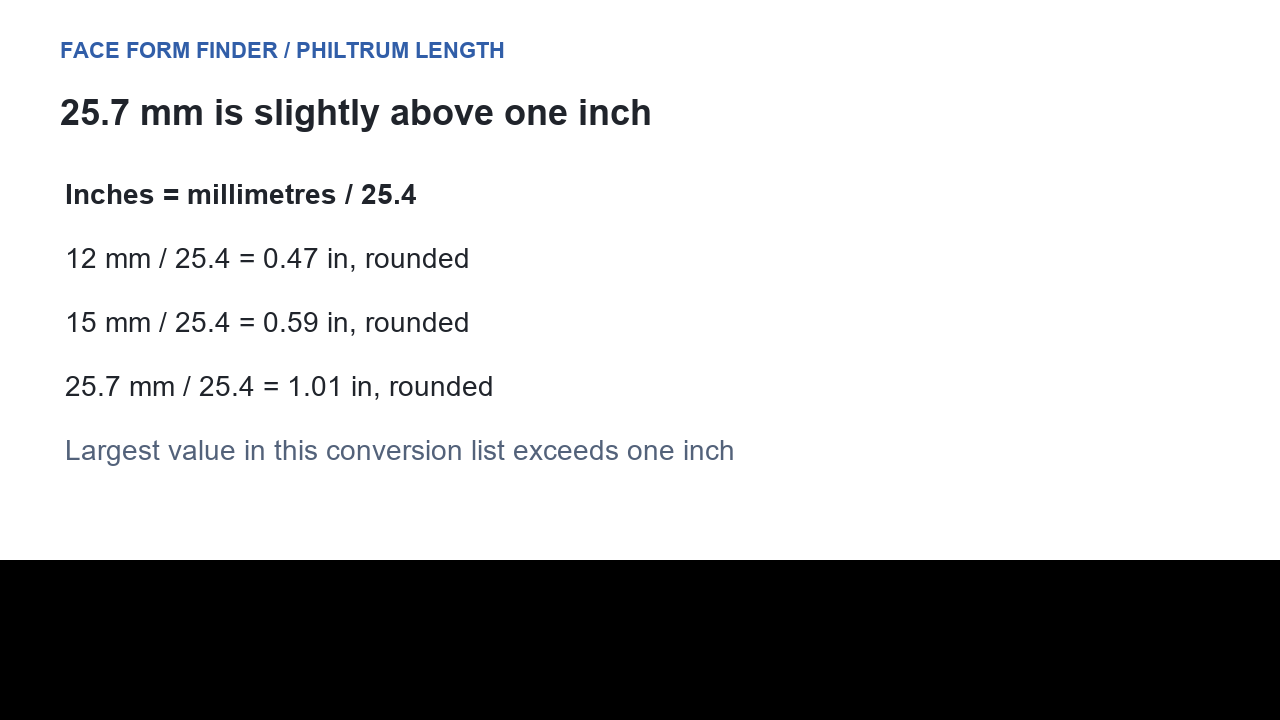
Millimetres and inches
Divide millimetres by 25.4. Rounded to two decimal places: 11 mm = 0.43 in; 12 mm = 0.47 in; 13 mm = 0.51 in; 15 mm = 0.59 in; 18 mm = 0.71 in; 20 mm = 0.79 in; 22 mm = 0.87 in; 25.7 mm = 1.01 in. These are calculated unit conversions. The largest value in this conversion list is slightly above one inch, not inside it.
Each figure, with the date it was printed
Each row below is a figure as one page printed it, sorted oldest first, with the date that page carried. Where a page stated the span its figure runs across, that is in the last column. A page that printed no date is marked as such rather than guessed at.
| Date | Who, as they describe themselves | Figure | Span |
|---|---|---|---|
| March 22, 2019 | a dental-hygiene clinic answering a reader’s question | 15 mm is the questioner's stated reference, not a confirmed clinic cut-off | not printed |
| March 5, 2025 | a 570-person survey of preferred lip proportions | each 0.65 mm less philtrum went with 0.15 mm more upper vermillion | not printed |
| May 27, 2026 | a London facial clinic’s patient page | long above 11–13 mm (women), 13–15 mm (men) | the base of the nose to the top of the upper lip |
| July 19, 2026 | a Korean clinic’s blog | a reference range of 11–18 mm (women), 13–22 mm (men), and a mean of 25.7 mm across 76 of its own patients | subnasale to the red border of the upper lip |
| July 25, 2026 | a reviewed how-to article | long above 12 mm (women), 15 mm (men) | the base of the nose to the top of the upper lip |
| October 7, 2026 | a measurement-focused review | an average of 20 ± 2 mm (women), 22 ± 2 mm (men) | the mid-philtral height |
| date not printed | a lip-lift surgeon’s photo page | an ideal of roughly half an inch, written 11–13 mm | the base of the nose to the red of the lip |
Sorted oldest first, the rows set out which pages printed a cut-off and the date each page carried. Two rows carry a cut-off for long; the rest carry a target, a range, an average or an ideal. The dates are the ones each page carried, and the figures are the ones each page printed.
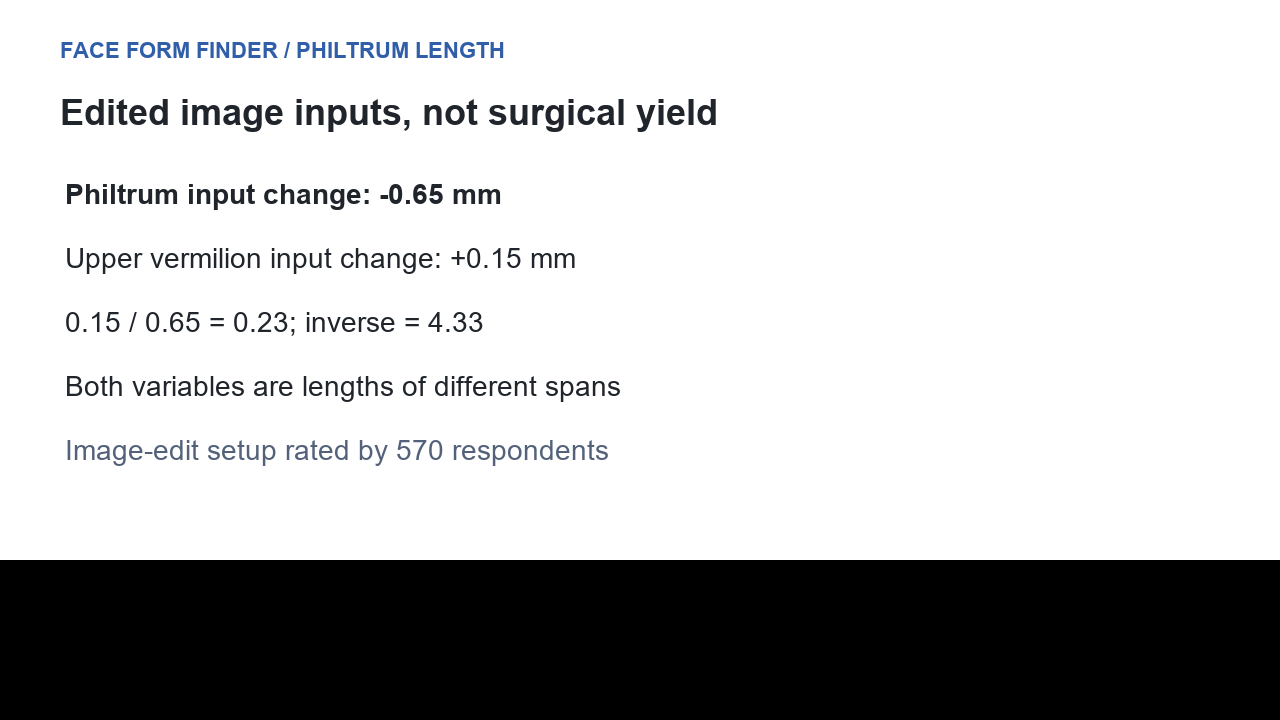
Two lengths in an image-editing setup
In a simulated image set rated by 570 respondents, a 0.65 mm reduction in philtrum length was paired with a 0.15 mm increase in upper vermilion height during image editing. Both quantities are lengths, but they concern different spans. Calculated upper-vermilion change divided by philtrum change is 0.15 / 0.65 = 0.23; the inverse is 0.65 / 0.15 = 4.33. These ratios describe the editing inputs, not a measured surgical outcome or a causal exchange rate.
A date attached to a record does not establish that its numbers stayed unchanged in the years since publication.
Incomplete self-reported records
Compiled October 12, 2026. Five self-reported entries are shown below. Two give starting and ending numbers; one of these requires an explicit contextual interpretation of the ending unit. Measurement instruments, conditions and landmarks are not established for the entries. Amount of skin removed is not assumed equal to change in measured philtrum length. These records are not clinical outcomes or a safe-reduction range.
| Started at | Ended at | Reported removal or calculated difference | Time after at original self-report |
|---|---|---|---|
| 21 mm | not given | 6 mm taken off, as stated | two years |
| 2 cm (20 mm) | 1,1 as written; interpreted as 1.1 cm (11 mm), ending unit not repeated | 9 mm calculated only if the contextual centimetre interpretation is correct | two months, as stated |
| 18 mm | 12–13 mm | 5–6 mm, worked out from the two ends | not stated |
| 19 or 20 mm | not given | 5 or 6 mm taken off, as stated | reporting interval not stated; settling over months described |
| not given | not given | 2 mm taken off, as stated | not stated |
The 2 cm-to-1,1 entry uses a decimal comma; reading the final number in centimetres is a contextual interpretation, not an explicitly repeated unit. It would yield 20 - 11 = 9 mm under that interpretation. The 18-to-12-or-13 mm entry yields a calculated difference of 5-6 mm. The other rows describe an amount removed without a stated final measurement. Follow-up descriptions are incomplete; the entries cannot establish a complete follow-up order. A 2 mm removal is accompanied by regret in its self-report; that does not establish a general risk rate for 2 mm procedures.
Photographs and decisions
An optional photo-comparison setup is a full-face rear-camera image from four or five feet away, using a timer and then cropping. This is a proposed setup, not calibrated millimetre measurement or a guarantee that perspective differences vanish. A phone model name alone is not a calibrated measurement setup.
Pictures, anecdotal records and a single length cannot establish surgical suitability. A number alone cannot establish mouth-closure function. A self-reported account of three consultation refusals includes uncertainty about self-perception; it is not proof that anatomy was irrelevant or a diagnosis.
A hypothetical ratio example
A defined 40 mm chin divided by a 20 mm philtrum gives 2.00. If the hypothetical philtrum input alone becomes 14 mm, 40 / 14 = 2.86. This is an input-change calculation, not a forecast of what removing 6 mm of skin would do to a face.
Keep a comparable record
Record the two landmarks, capture conditions and whether the value is measured, calculated or self-reported. If the endpoint or instrument is unknown, retain that uncertainty instead of converting it into a treatment target.
Compare ratio definitions; record lip observations.
The 98-second version
If the player does not load, watch it on YouTube: Philtrum Length: Three Cut-offs, and the Line Each One Stops At.