FACE FORM FINDER · 6 OCTOBER 2026
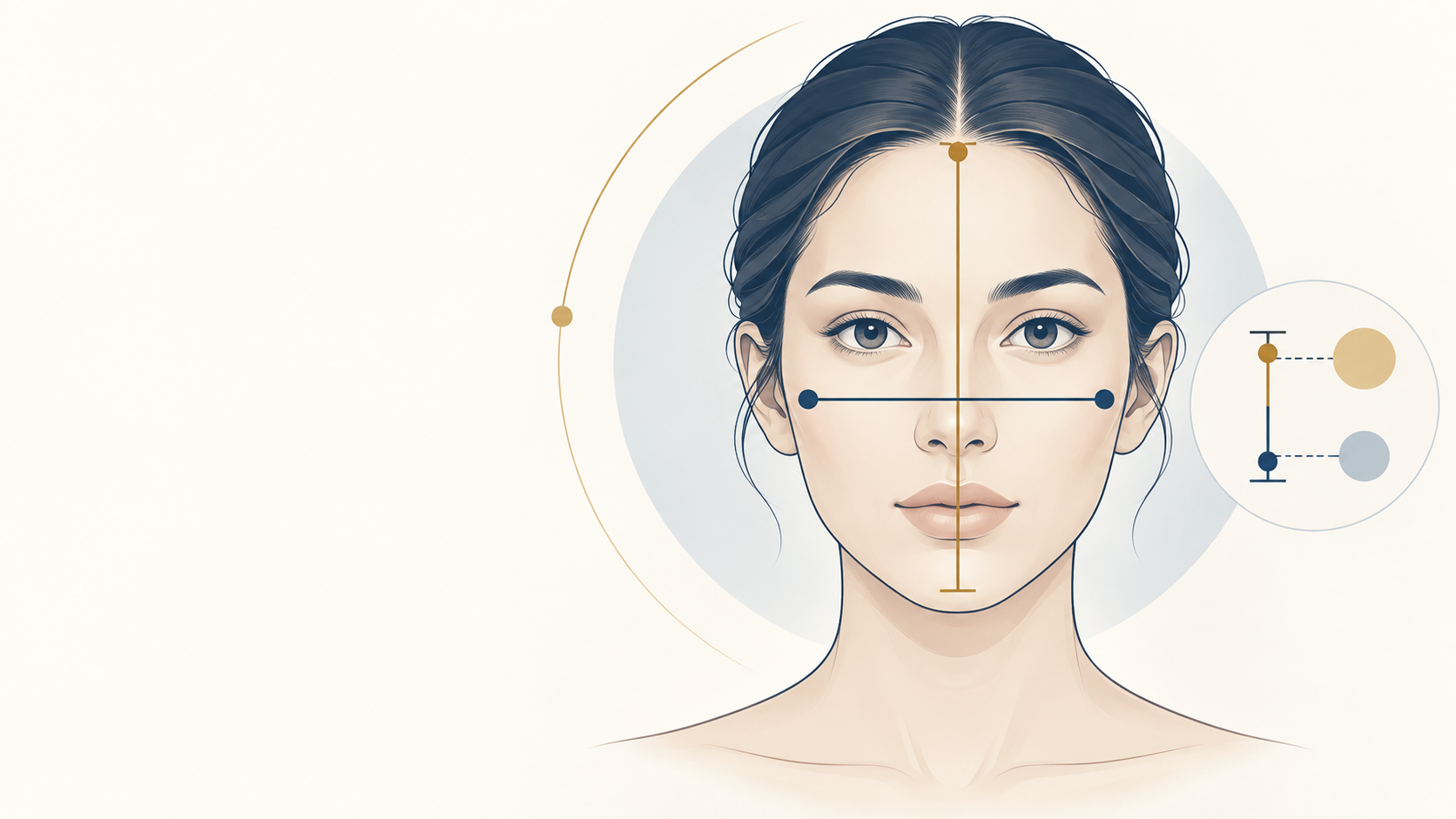
Golden Ratio Face
Each proportion, written as a length
A ratio hides its own two lengths. "1.568" does not say whether the face runs long or the width runs wide, and it does not say which of the two moved. Millimetres do say. Each row below takes one length as the given, works out the length phi asks for, and puts the reference face's own length beside it. The gap column is what the face reads minus what phi asks for.
| Proportion | Target | Given length | Phi asks for | Reference face reads | Gap |
|---|---|---|---|---|---|
| Face length ÷ face width | 1.618 : 1 | hairline midpoint to chin tip, 185 mm | 114.3 mm | 118 mm | +3.7 mm |
| Mouth width ÷ nose width | 1.618 : 1 | mouth corner to mouth corner, 48 mm | 29.7 mm | 35 mm | +5.3 mm |
| Face width ÷ single eye width | 5 : 1 | cheekbone to cheekbone, 118 mm | 23.6 mm | 30 mm | +6.4 mm |
| Face width ÷ nose width | 5 : 1 | cheekbone to cheekbone, 118 mm | 23.6 mm | 35 mm | +11.4 mm |
| Facial thirds | 1 : 1 : 1 | hairline midpoint to chin tip, 185 mm | 61.7 mm each | 62 / 61 / 62 mm | +0.3 / −0.7 / +0.3 mm |
Read the first row as the worked example. Face length is 185 mm. Phi asks for a width of 114.3 mm, because 185 ÷ 1.618 = 114.3. The reference face measures 118 mm across the cheekbones, so it is 3.7 mm wider than the proportion asks for. The ratio alone said 1.568 against a target of 1.618, which does not say where that 3.7 mm sits. The lengths do: it sits on the width.
The third and fourth rows come from the fifths canon rather than from phi. It divides the face into five equal widths across, so one eye and the nose are each meant to be one fifth of the face width. On a face 118 mm across, that is 23.6 mm for each. The eye here measures 30 mm and the nose 35 mm, which is why both rows carry a positive gap.
The reference face, in millimetres
The distances below are a fixed reference set in millimetres, assembled so the proportions above can be checked rather than taken on faith. It is a defined reference, not a person, and a real face will not land on these numbers. The vertical bands close on each other: 62 + 123 = 185, and 61 + 62 = 123.
| Distance | mm | What it marks |
|---|---|---|
| Hairline midpoint to the tip of the chin | 185 | face length, hairline start |
| Brow line to the tip of the chin | 123 | face length, below the hairline |
| Hairline midpoint to the brow line | 62 | upper third |
| Brow line to the base of the nose | 61 | middle third |
| Base of the nose to the tip of the chin | 62 | lower third |
| Cheekbone to cheekbone | 118 | face width, cheekbone |
| Jaw corner to jaw corner | 105 | face width, jaw |
| Inner eye corner to outer eye corner | 30 | one eye width |
| Nostril to nostril | 35 | nose width |
| Mouth corner to mouth corner | 48 | mouth width |
| Pupil to pupil | 62 | eye spacing across |
| Nose root to the base of the nose | 52 | nose height |
| Base of the nose to the top of the upper lip | 15 | philtrum and lip peak |
| Lip line to the tip of the chin | 43 | lower lip and chin |
| Hairline midpoint to the nose root | 71 | forehead height |
Two of these rows are worth keeping apart. Hairline to chin is 185 mm; brow to chin is 123 mm. That is the same face, and the two lengths differ by 62 mm. A page that writes "face length" without saying which start it used has left the largest single number in the reading undecided.
What the millimetres change
The canon disagrees with itself on this face. The thirds come out at 62 / 61 / 62 mm, which is within a millimetre of the equal-thirds rule the same canon asks for. The phi rows do not come out that way: the same face misses the width proportion by 3.7 mm, and the two fifths rows by 6.4 mm and 11.4 mm. These are different numerical deviations on the same defined reference face. No pass threshold is assigned here.
Millimetres also survive the step where a ratio is hardest to hold on to. A score out of 100 is a number on a scale that the page defining it chose, and two pages can return two different scores from the same face without either being wrong. "118 mm against a target of 114.3 mm" is a length you can put a tape on, but a measurement also depends on consistent endpoints and repeated readings.
More of the canon, written in millimetres
The canon carries more proportions than the five rows above. Each one below is written the same way: a length the canon fixes, the length it asks for beside it, and what the reference face reads.
| Proportion | Target | Given length | Asks for | Reference face reads | Gap |
|---|---|---|---|---|---|
| Inner eye corner to inner eye corner | 1 : 1 with one eye width | inner eye corner to outer eye corner, 30 mm | 30 mm | 32 mm | +2 mm |
| Pupil centre to lip line ÷ lip line to chin | 1.618 : 1 | lip line to chin tip, 43 mm | 69.6 mm | 80 mm | +10.4 mm |
| Nose base to lip line ÷ lip line to chin | 1.618 : 1 | lip line to chin tip, 43 mm | 26.6 mm | 19 mm | −7.6 mm |
| Eye spacing ÷ mouth width | 1.618 : 1 | pupil to pupil, 62 mm | 38.3 mm | 48 mm | +9.7 mm |
| Nose length ÷ philtrum | 1.618 : 1 | nose root to nose base, 52 mm | 32.1 mm | 15 mm | −17.1 mm |
| Forehead ÷ lower face | 1.618 : 1 | nose root to chin tip, 114 mm | 184.5 mm | 71 mm | −113.5 mm |
Five of these rows are ordinary misses of a few millimetres. The last one is not, and it is worth reading twice. Hairline midpoint to nose root is 71 mm, and nose root to chin tip is 114 mm. For the upper length to be 1.618 times the lower, the forehead would have to read 184.5 mm — longer than the whole face, which is 185 mm. Read the other way round, the lower face asks for 114.9 mm against its 114 mm, a gap of 0.9 mm. The same proportion is either the largest miss on this page or the smallest, and nothing in the ratio says which of its two lengths is being divided.
The second ratio set, on the same face
A second pair of readings is in use for the same face. Neither is phi. One divides a vertical span by the face length, the other divides a horizontal span by the face width, and both are stated as a fraction of the face rather than against 1.618. Written as lengths, they land on the reference face like this.
| Reading | Target | Given length | Asks for | Reference face reads | Gap |
|---|---|---|---|---|---|
| Width ratio | 0.46 | cheekbone to cheekbone, 118 mm | 54.3 mm | 62 mm | +7.7 mm |
| Length ratio | 0.36 | hairline midpoint to chin tip, 185 mm | 66.6 mm | 80 mm | +13.4 mm |
Each of these readings also carries a spread, and the spread is what makes a gap readable. The width ratio is given as 0.46 with a spread of 0.022, and the length ratio as 0.36 with a spread of 0.017. On a face this size those spreads are 2.6 mm and 3.1 mm. The headline gap at the top of this page is 3.7 mm, which is about one spread wide — inside the band the reading itself carries.
One face, several face lengths and face widths
The reference face carries two face lengths and two face widths, and the headline ratio takes a different value with each pair. That is not a defect in the arithmetic. It is what an undefined endpoint does to a single number.
| Reading | mm |
|---|---|
| Face length, hairline midpoint to chin tip | 185 |
| Face length, brow line to chin tip | 123 |
| Face width, cheekbone to cheekbone | 118 |
| Face width, jaw corner to jaw corner | 105 |
The two lengths differ by 62 mm and the two widths by 13 mm. Divide the hairline length by the cheekbone width and the face reads 1.568 against a target of 1.618. Divide the same length by the jaw width and it reads 1.762. Divide the brow length by the cheekbone width and it reads 1.042. One face, one canon, three ratios — and the ratio on its own does not say which pair of lengths produced it.
Reading a proportion as a length at home
Pick the length you can reach, work out what phi asks for, and compare. Face length is the usual starting point: measure from the hairline midpoint straight down to the chin tip, divide by 1.618, and the answer is the width phi asks for. Measure across the cheekbones and subtract. Record repeated readings before treating a small difference as a stable result. This example supplies no measured tape-error threshold.
Do the same for mouth over nose. Measure the mouth corner to corner, divide by 1.618, and compare with the nostril-to-nostril width; keep the endpoints consistent for both lengths. Whichever length you start from, write down which one it was - a proportion kept as a single number has lost the two lengths it came from.
What the golden ratio face tools disclose
The arithmetic above is repeatable by hand. A calculator decides parts of it for you, so the table below compares six tools. A 0 means the page did not disclose that field - it is not a product value, and it is not a zero measurement.
| Disclosure field | Golden Ratio Face | The Face Report | Golden Face Ratio | Oblong Face Shape | Miroir | BeautyScan |
|---|---|---|---|---|---|---|
| Captured | 2026-10-06 | 2026-10-06 | 2026-10-06 | 2026-09-27 | 2026-09-27 | 2026-09-27 |
| Declared landmark count | 0 | 478 | 468 | 68 | 0 | 0 |
| Stated input cap (MB) | 0 | 30 | 0 | 10 | 0 | 0 |
| Publicly enumerated ratio or proportion items | 3 | 8 | 5 | 3 | 0 | 0 |
| Printed phi reference | 1.618 | 1.618 | 1.618 | 1.618 | 0 | 0 |
| Stated score bands | 0 | 4 | 0 | 5 | 0 | 0 |
Each column carries the date it was read. The three columns on the left were read on 6 October 2026. The other three carry their last reading date, 27 September 2026, and their pages have not been read since. Read a 0 against the date in its column: a 0 says the page did not disclose that field on the date shown, not that the product has no value for it.
Some tools combine several proportions into a headline score. The headline alone does not identify which proportion produced it. Read the proportion you care about, and keep its two lengths beside it.
Same image, three outputs
One synthetic, non-identifying, front-facing test image. The three outputs below were collected 28 September 2026.
| Tool | Output | Collected |
|---|---|---|
| Golden Ratio Face | 86% | 2026-09-28 |
| The Face Report | 77 / 100 | 2026-09-28 |
| Golden Face Ratio | 71.31% | 2026-09-28 |
Read a result in four steps
- Write the exact ratio the product claims to calculate.
- Name the two endpoints and the denominator.
- Check that the photo includes those points without hair, tilt or crop changing them.
- Read the score only against that product's own reference.
Golden ratio face questions
What is a golden ratio face?
A face whose proportions sit close to phi, 1.618. The headline reading is face length divided by face width; the classical set adds more, each one facial length divided by another. On the reference face here four of the five rows miss by 3.7 mm to 11.4 mm; the thirds row misses by less than a millimetre.
Is a face phi ratio the same as a golden ratio face?
Yes. Face phi ratio, golden proportion, golden number face and beauty ratio face are names for the same division of one facial length by another against 1.618. The name alone does not fix which two points the lengths run between, which is the part the millimetre table above supplies.
Is a beauty ratio face measured a different way?
No. A beauty ratio face uses the same two-length division. The word beauty describes what the number is claimed to predict, not how it is calculated, and the arithmetic does not change with the label.
Can I work out a golden ratio face at home?
Yes, with a soft tape. Take one length, divide or multiply by 1.618, and compare with the length phi asks for. Record which length you started from - the ratio on its own has lost it.
Is 1.618 a universal perfect-face number?
No. It is a mathematical reference. It becomes a face measurement only when the two lengths and their named endpoints are specified, and a face that misses it is not thereby a worse face.
Why do two golden ratio face scores differ?
The products may choose different landmarks, crops, ratios and score conversions. Compare those methods before comparing the percentages.
Can a face score tell me what to change?
No. A photo score summarises the product's own method. It cannot prescribe an appearance change or explain a health concern.
For an outline-based reading instead of a proportion score, return to the face shape detector and fit guide.
Related guides
- Midface Ratio — the middle third on its own, and the length that starts at the brow.
- Facial Width to Height Ratio — the width reading that is not the golden ratio, and the different question it answers.
- Face Shape Chart — the four measurements, and how to check the thirds at home with a soft tape.
- Face Symmetry Test — the left-right reading that a proportion cannot see.
- What Is My Face Shape? — the readings most guides ask you to take, and why one head can read two shapes.