FACE FORM FINDER · 8 OCTOBER 2026
Canthal Tilt
The tables below are worked out from that geometry, and the arithmetic is left visible so it can be repeated. This page is about reading the angle off a photograph and about the bands other pages print. It is not about which angle is preferable, and a number here is a direction and a size rather than a score.
The angle is the arctangent of a ratio
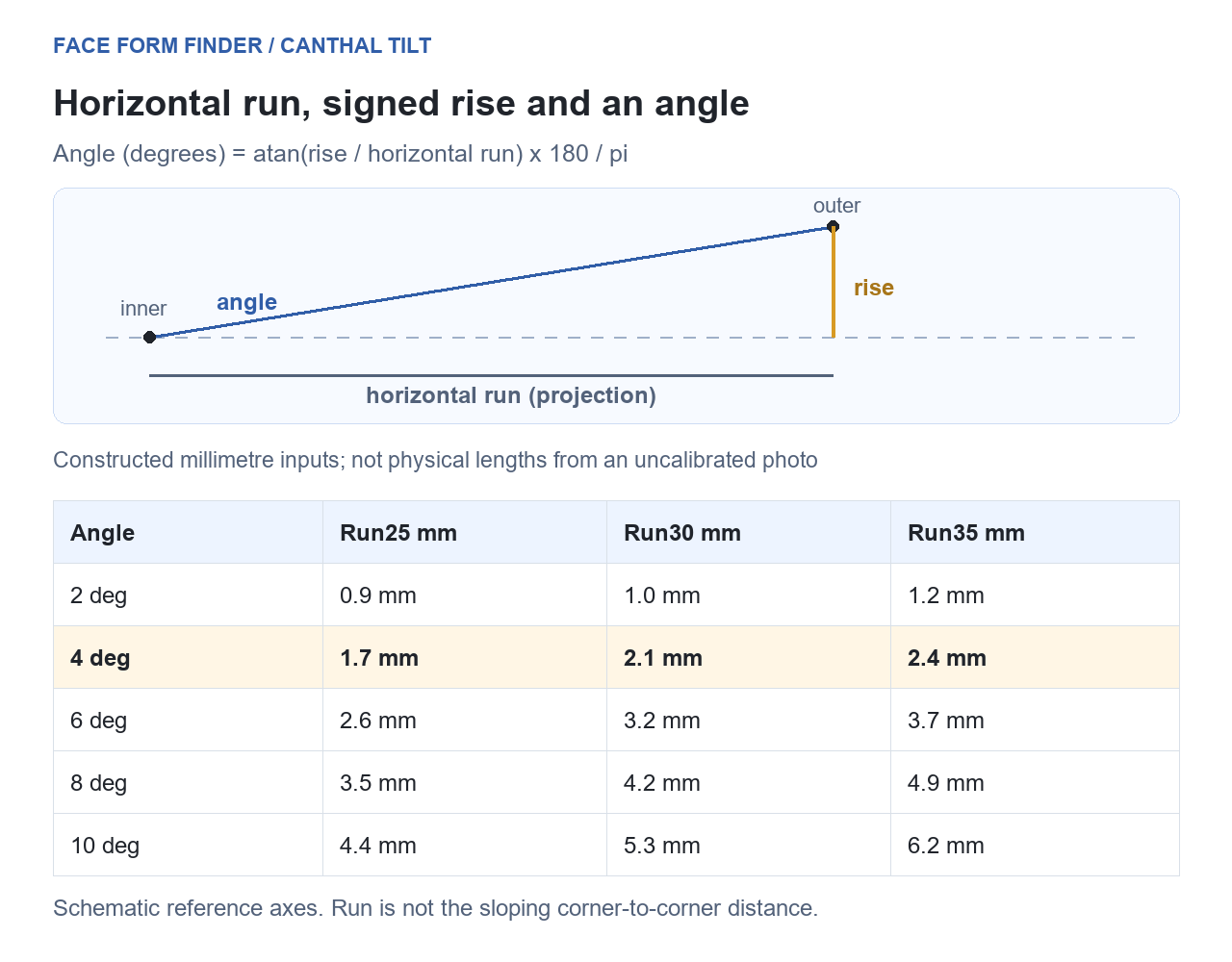
Draw a line from the inner corner of the eye to the outer corner. If the outer corner sits above the inner one the tilt is positive; if it sits below, negative; level is neutral. The size of the tilt is the angle that line makes against the horizontal.
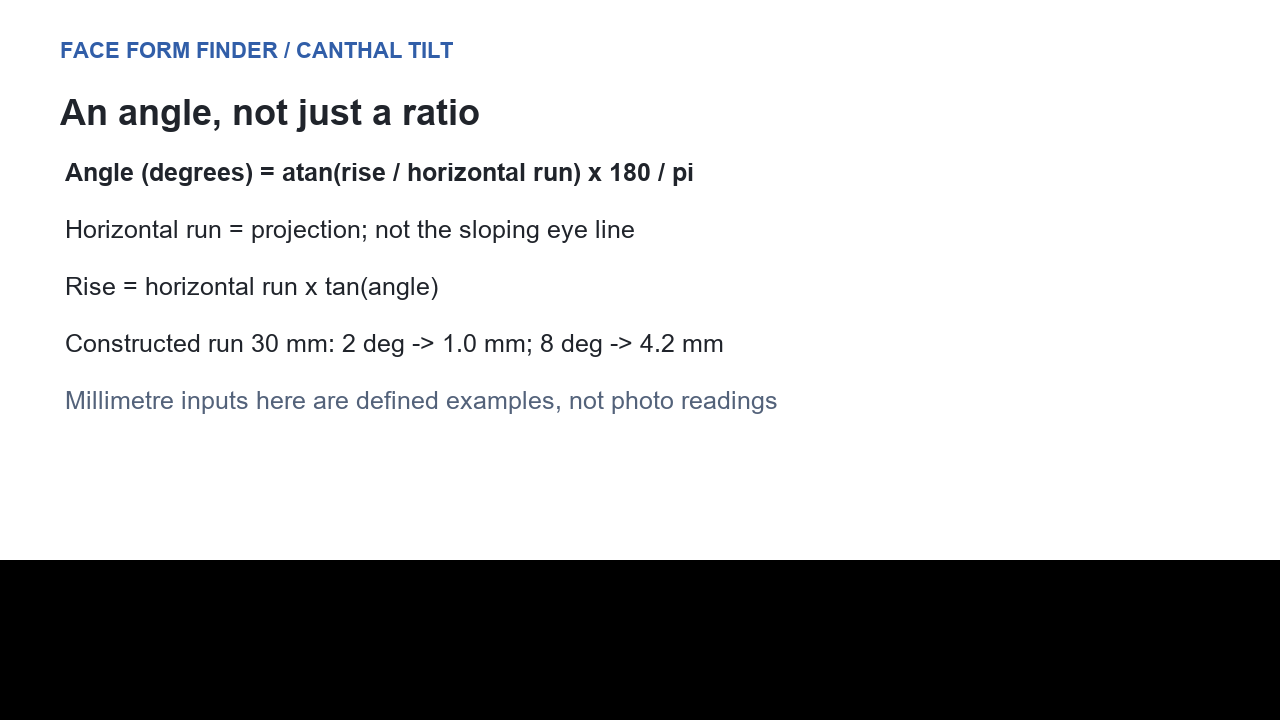
Choose a reference horizontal axis. Run is the positive horizontal projection of the corner separation along that axis; rise is the signed perpendicular displacement, positive when the outer corner is above the inner corner. With both distances in the same units, the calculated angle in degrees = atan(rise / run) x 180 / pi. A sloping corner-to-corner distance is not the run used in this formula.
The rise that gives each angle
Read down for the angle and across for the horizontal run between the corners. Each cell is the rise, in millimetres, that the outer corner has to sit above the inner one to reach that angle.
| Canthal tilt | 25 mm horizontal run | 30 mm horizontal run | 35 mm horizontal run |
|---|---|---|---|
| 2° | 0.9 mm | 1.0 mm | 1.2 mm |
| 4° | 1.7 mm | 2.1 mm | 2.4 mm |
| 6° | 2.6 mm | 3.2 mm | 3.7 mm |
| 8° | 3.5 mm | 4.2 mm | 4.9 mm |
| 10° | 4.4 mm | 5.3 mm | 6.2 mm |
The whole table is worked out on 2026-10-08 from the horizontal run multiplied by the tangent of the angle. A wider horizontal run needs a larger rise for the same angle: 4 degrees is 1.7 mm on a 25 mm horizontal run, 2.1 mm on a 30 mm horizontal run and 2.4 mm on a 35 mm horizontal run.
Working it backwards from a photograph
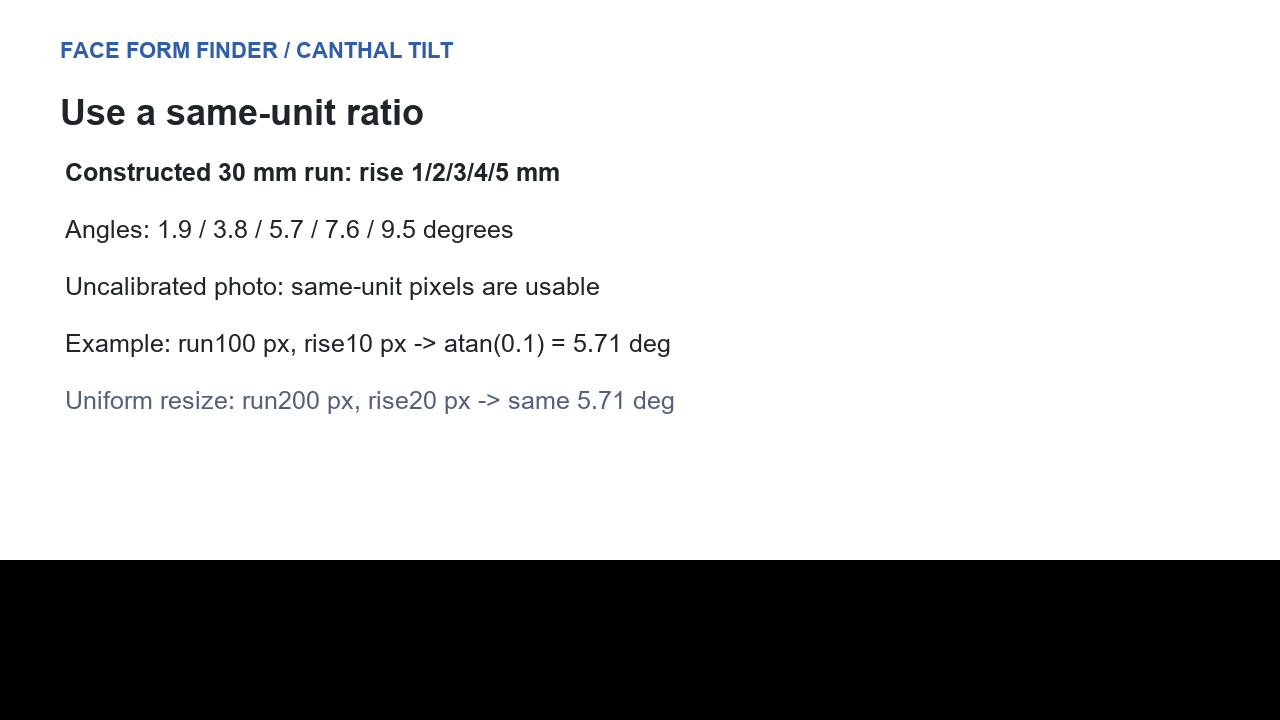
On a photograph the two lengths are what you can measure and the angle is what follows. On a 30 mm horizontal run, a rise of 1 mm is 1.9 degrees, 2 mm is 3.8, 3 mm is 5.7, 4 mm is 7.6 and 5 mm is 9.5. Each of those is the angle whose tangent is the rise over the horizontal run, worked out here rather than read off a page.
Because the horizontal run is the denominator, the same rise gives a smaller angle on a wider eye. A 2 mm rise is 4.6 degrees on a 25 mm horizontal run and 3.3 degrees on a 35 mm horizontal run. The constructed 25 mm and 35 mm runs with the same 2 mm rise yield 4.6 and 3.3 degrees; these are not two observed people.
The bands the pages on the first page print
Three of the pages on the first page for this term put a number on the angle. They do not put the same kind of number on it.
| Page on the first page | What it puts on the angle |
|---|---|
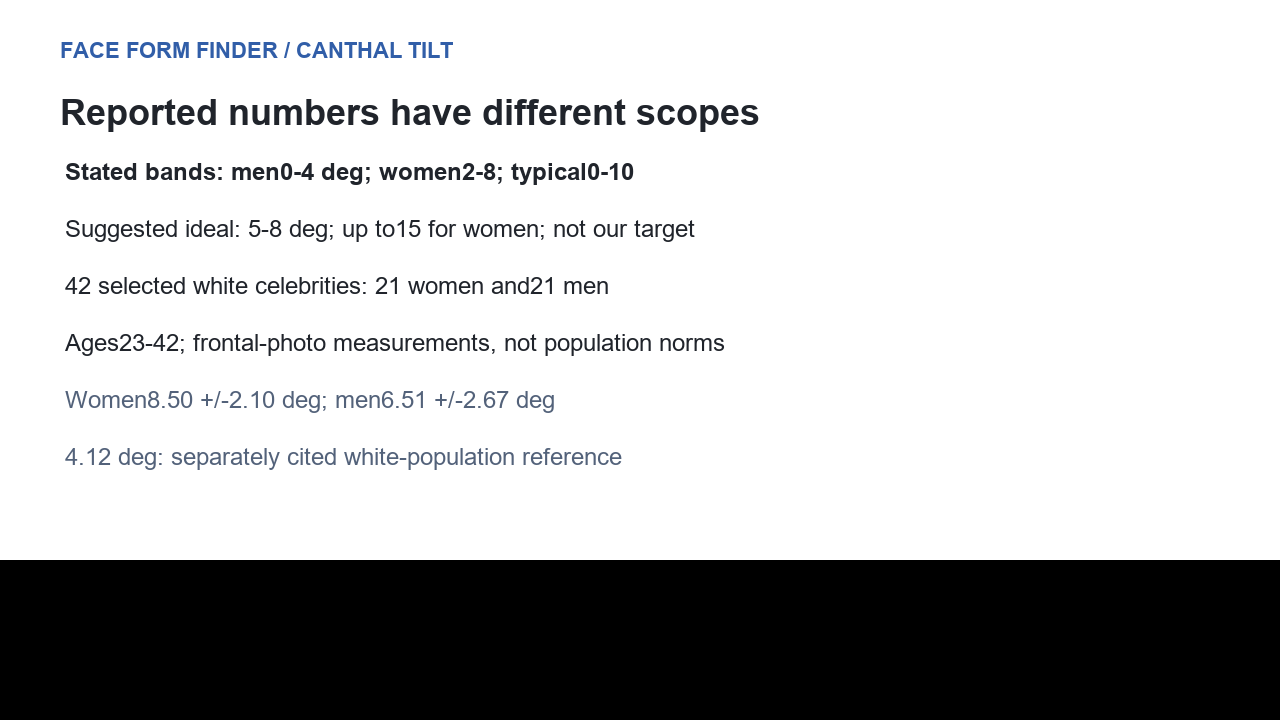
| QOVES | men 0° to +4°, women +2° to +8°, and a typical range of 0° to +10° |
| wikiHow | an ideal of 5° to 8°, and up to 15° for women |
| 42 selected white celebrities: 21 women and 21 men, ages 23-42 | Frontal-photo measurements: women 8.50° ± 2.10°, men 6.51° ± 2.67°. Editorial/model/casting selections, not a general-population sample. The separately cited 4.12° reference for average white faces is not the mean of these 42. |
These three figures were read from the front page of results for this term on 2026-10-08, and they are quoted as each page prints them.
The three are different kinds of number. A stated interval is a descriptive convention, not demonstrated population frequency. A suggested ideal is an aesthetic claim, not this site's target. A sample mean describes only the selected photograph set; it is not a universal average. The rise that gives a given angle does not depend on any of them.
What the photograph has to be
One page on the first page gives the conditions for the reading: a relaxed head position with the eyes looking straight into the camera. Head tilt changes the answer, and that is arithmetic rather than opinion. Head roll can change an angle read against the image's fixed horizontal. An angle relative to a specified head reference line is a different measurement. State the reference and head pose; a straight-on photo does not by itself remove roll or perspective.
In an uncalibrated photo, measure rise and horizontal run in the same pixel units to calculate their ratio; do not call those pixels a person's millimetres. Uniformly resizing the image preserves that ratio, but unequal stretching does not. The 25, 30 and 35 mm inputs in these tables are defined construction values, or may stand for calibrated lengths; they were not obtained from an arbitrary photo.
A constructed pixel example uses a horizontal run of 100 pixels and a rise of 10 pixels: atan(10 / 100) x 180 / pi = 5.71 degrees, rounded. Uniformly resizing to 200 pixels and 20 pixels preserves that ratio. This proves scale cancellation in the constructed ratio, not a physical millimetre measurement or immunity to perspective.
The line the angle is read against
The angle is measured against the horizontal, and on a face there is more than one way to place that horizontal. One page on the first page reads the axis against a true-horizontal line drawn through the inner corner, and names a head-position reference used in cephalometry as the alternative. A tilt quoted without its reference line is only partly specified, do not infer a one-degree tolerance from a change of reference.
The rise each angle needs on three horizontal runs, the same arithmetic read backwards, and the three figures printed on the first page, as a CSV.
One angle, three horizontal runs
Questions
What is canthal tilt?
It is the angle between the line that joins the inner and outer corners of the eye and the horizontal. An outer corner above the inner one reads positive, below reads negative, and level reads neutral. It is measured in degrees.
How do I measure my canthal tilt?
Take a straight-on photograph with a relaxed head. Mark the inner corner and the outer corner of one eye, measure the horizontal projection and signed rise in the same reference system and the same pixel units, then divide rise by horizontal run. The angle is the arctangent of that fraction. On a 30 mm horizontal run, 2 mm of rise is 3.8 degrees.
What is a positive canthal tilt?
A positive tilt is one where the outer corner sits above the inner corner. The size is an angle in the stated reference system. The 0 to +4 and +2 to +8 degree intervals are stated descriptive intervals, not verified universal population ranges.
What is the average canthal tilt?
There is no universal average established here. In the photo-measured selected set of 42 white celebrities, ages 23-42, the 21 women averaged 8.50 degrees and the 21 men 6.51 degrees. The 4.12-degree figure is an outside reference cited separately, not the combined mean of that selected set.
Does canthal tilt change with age?
One page on the first page describes the outer corner dropping as the support around the eye loosens, which pulls a positive angle back toward neutral. A change read this way is a change in the angle, and the same arithmetic applies to it as to any other reading.
Related guides
- Eye Shape Chart — the tilt of the eye opening as one of seven readings, in millimetres and degrees.
- Eyebrow Shape Chart — the brow above the eye, read the same way.
- Deep-Set Eyes — the distance that records depth, which a corner angle does not.
- Hooded Eyes — how much of the upper lid stays visible, and the strip that decides it.
- Face Shape Chart — the readings that build a face shape from the brow ridge down.
- Face Symmetry Test — the left-right reading of the same photograph.
Illustrated explanation
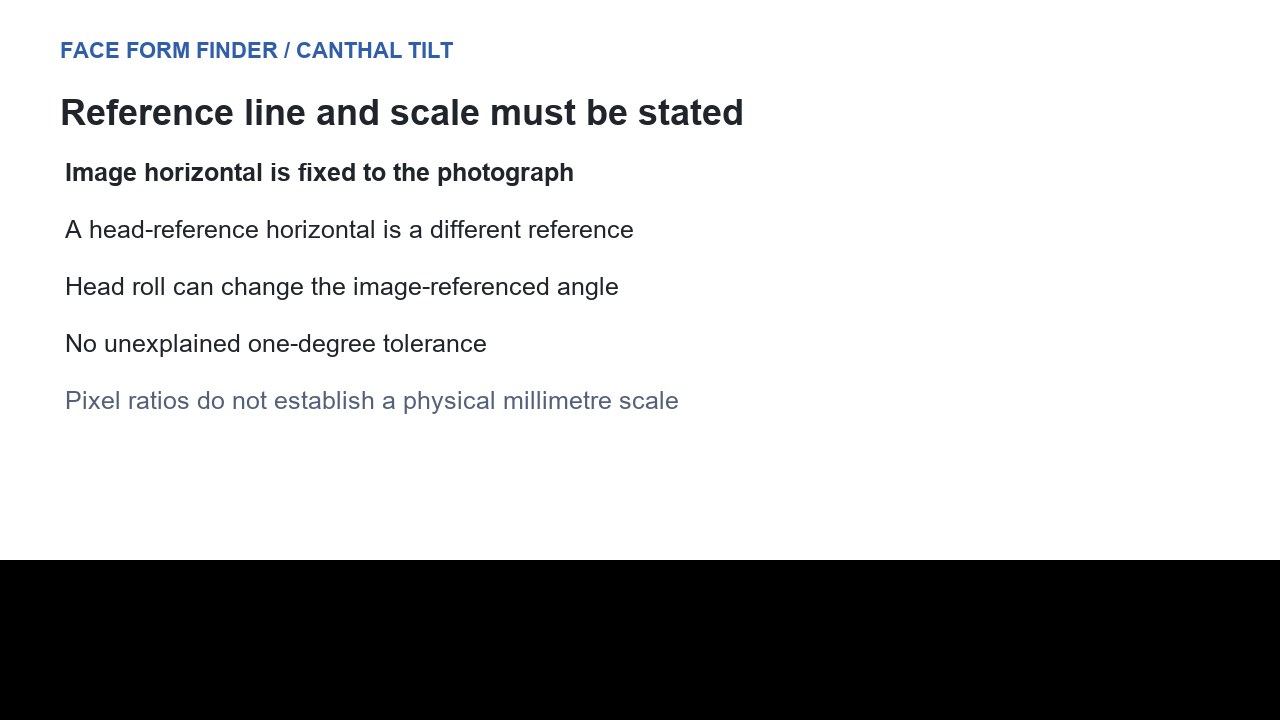
If the player does not load, watch the 2:43 version on YouTube: Canthal Tilt: Arctangent, Reference Line and Photo Scale.