FACE FORM FINDER · 2 OCTOBER 2026
Mustache Styles
The five measurements the lip gives you
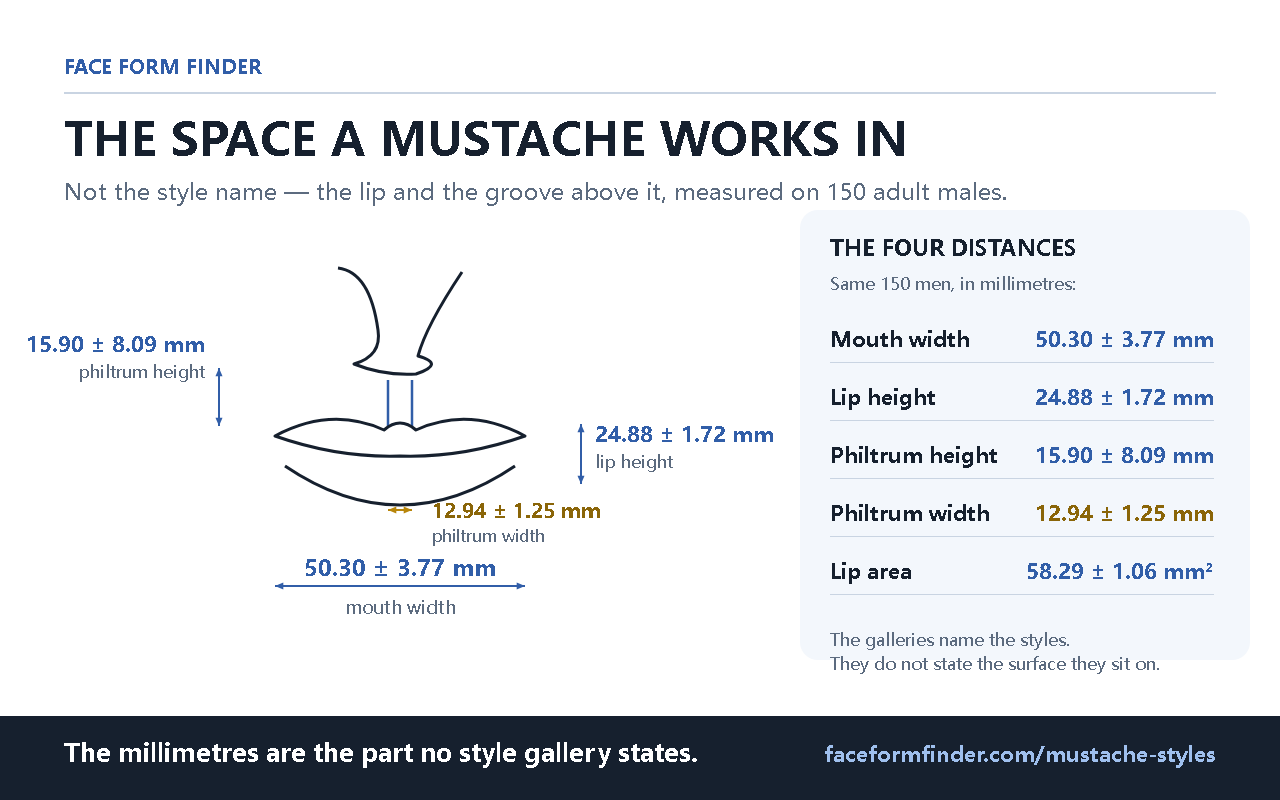
Every style on this page sits on the same five lengths. They were taken on 300 medical students in eastern Nepal, 19 to 24 years old, 150 of them male, with a digital vernier caliper and the lips closed. The middle column is that group; the fourth column is what other measured populations put beside it.
| What is measured | What it runs between | Adult males (n = 150) | Other population measurements | Which style decision leans on it |
|---|---|---|---|---|
| Mouth width | corner of the mouth to corner of the mouth | 50.30 ± 3.77 mm | 47.17 (North Indian, n = 300); 47.3 (Malaysian Indian, n = 50); 48.8 (Malay, n = 50); 53.5 (Western Indian); 54.1 (White American, n = 50) | how far a style can run before it passes the mouth corner — the Western, the Horseshoe and the Fu Manchu all extend past it |
| Lip height | top edge of the upper lip to the bottom edge of the lower lip | 24.88 ± 1.72 mm | no figure in the comparison set | how much vertical band a Chevron or a Walrus has to cover before it reads full |
| Philtrum height | base of the nose to the top of the upper lip | 15.90 ± 8.09 mm | 14.19 (Indonesian); 14.30 (Central Nepal, n = 400); 10.40 (Malay, n = 50); 17.93 (Mashad) | how much bare skin sits between the nose and the top of the mustache |
| Philtrum width | the groove’s own width | 12.94 ± 1.25 mm | 13.86 (Indonesian); 11.85 (Central Nepal, n = 400); 12.71 (Malay, n = 50); 14.98 (Mashad) | where a centre part can be cut — the English, the Pencil and the Dali all split here |
| Lip area | the red of both lips together | 58.29 ± 1.06 mm² | 59.53 (Mashad) | how much lip a Pencil leaves bare, and how much a Chevron has to cover |
Read the spread before the average. The philtrum height carries the widest spread in the set — 15.90 mm with a standard deviation of 8.09, so the average is a weak description of any one face. Mouth width is the tightest, and it still moves 7 mm across the six populations listed. A style described only by a name tells you nothing about which of those lengths it was drawn against.
The centre of the mustache is a separate decision
The philtrum is the groove under the nose. An English or Pencil mustache can use a hard part at that groove. Positioning the line is a separate decision from choosing the overall mustache shape.
The mean philtrum width in the male group is 12.94 mm, with a standard deviation of 1.25 mm. That is a group average, not the available width on every face. It does not establish which groove suits a centre part better.
Grooming inference, not a measured fit rule. The millimetres describe anatomy. Linking those dimensions to the appearance of a centre part is an inference. No measured result says a part looks better on one philtrum than on another.
Shape choices and growth time
Common shape pairings include Chevron with square faces, Handlebar with oblong or square faces, Walrus with oval or triangular faces, Pencil with round faces, and Horseshoe with square jawlines. Beardstache combines a fuller mustache with short stubble. These pairings are styling suggestions, not measured fit thresholds.
Allow about a month for a Classic, as little as two weeks for a Pencil, and at least a month for a Half Measure with backing stubble cut to two or three millimetres. These are growth planning references, not guarantees of coverage.
Each style, read against the measurement it leans on
The measurement column connects each style to an anatomical landmark as a grooming inference. The face-shape column gives general styling suggestions; it does not validate the measurement as a fit rule.
| Style | What it does with the lip space | The measurement it leans on | General face-shape pairing | Tool |
|---|---|---|---|---|
| Chevron | covers the whole upper lip, with the edges angled down | lip height 24.88 mm — it is the style that has to cover the full band | square faces, strong features | comb and trimmer |
| Pencil | a thin strip along the top of the lip, clear of the red | philtrum width 12.94 mm — the strip is cut inside the groove’s width | round faces | razor and comb |
| English | split at the centre and pushed out horizontally | philtrum width 12.94 mm — the part is cut in the groove | No pairing specified | comb and wax |
| Handlebar | runs to the mouth corners, then curls upward | mouth width 50.30 mm — the ends start at the corner and travel past it | oblong or square faces | wax and comb |
| Walrus | hangs over the top lip | lip height 24.88 mm — it covers the band and then drops past it | oval or triangular faces | comb and scissors |
| Horseshoe | drops from the mouth corners down to the jaw | mouth width 50.30 mm — the vertical arms hang from the corners | square jawlines | trimmer |
| Western | carried past the mouth corners, without the curl | mouth width 50.30 mm — it is the same corner as the Handlebar, held flat | No pairing specified | comb and scissors |
| Beardstache | a full mustache sitting on short stubble | lip height 24.88 mm, plus stubble cut to 2–3 mm | No pairing specified | trimmer and clipper |
The measurement column is not a fit rule. It identifies a landmark relevant to the style, not the dimensions of your face or a threshold for choosing that style.
The 56-second version
If the player does not load, watch it on YouTube: Mustache Styles: The Space Above the Lip, Measured.
Questions
What is the most attractive mustache style?
The measurements here do not establish an attractiveness winner. They describe anatomical dimensions; they cannot rank how a mustache will look on you.
Do Amish men shave?
The measurements here cannot answer a question about a community’s shaving customs. That question is outside this style comparison.
What is the current mustache trend?
This comparison does not measure popularity over time. Use it to compare style features and grooming requirements, not to identify the most popular style.
Are mustaches back in style in 2026?
This comparison cannot establish a 2026 revival: it contains no year-to-year popularity measurements. A growth timeline tells you how long to allow for a style, not how many people wear it.
Can you wear a mustache without a beard?
Seven of the eight styles in the table are worked on the lip alone: Chevron, Pencil, English, Handlebar, Walrus, Horseshoe and Western are described without stubble. The Beardstache is the row that adds it — a full mustache sitting on short stubble cut to 2–3 mm. The trim tier for those seven is the tool each row names: a razor for the Pencil, wax for the English and the Handlebar, scissors for the Walrus and the Western, and a trimmer for the Chevron and the Horseshoe. Growth time on this page runs from as little as two weeks for a Pencil to about a month for a Classic. How a beard is shaped below the mustache is outside this page’s measurements.
What are the mustache style names?
The names used on this page are Chevron, Pencil, English, Handlebar, Walrus, Horseshoe, Western and Beardstache, with Classic and Half Measure named in the growth line. That is the set whose lip-measurement reading this page documents — not a complete naming glossary — and the downloadable CSV records where each row’s pairing came from. A name on its own still says nothing about which of the five lip lengths the style was drawn against.
Related guides
- Beard styles for face shapes — the full-beard version of the same face-shape question.
- Beard length chart — what each guard number leaves on the skin, in millimetres and inches.
- How to trim beard neckline — the neck edge, with the measured distances behind the two-finger rule.
- Face shape chart — confirm the outline before the style conversation.
- Beard styles for a round face — the round-face column, taken on its own.
The five lip measurements and eight style comparisons as a CSV.