FACE FORM FINDER · 4 OCTOBER 2026
Haircut for a Big Forehead
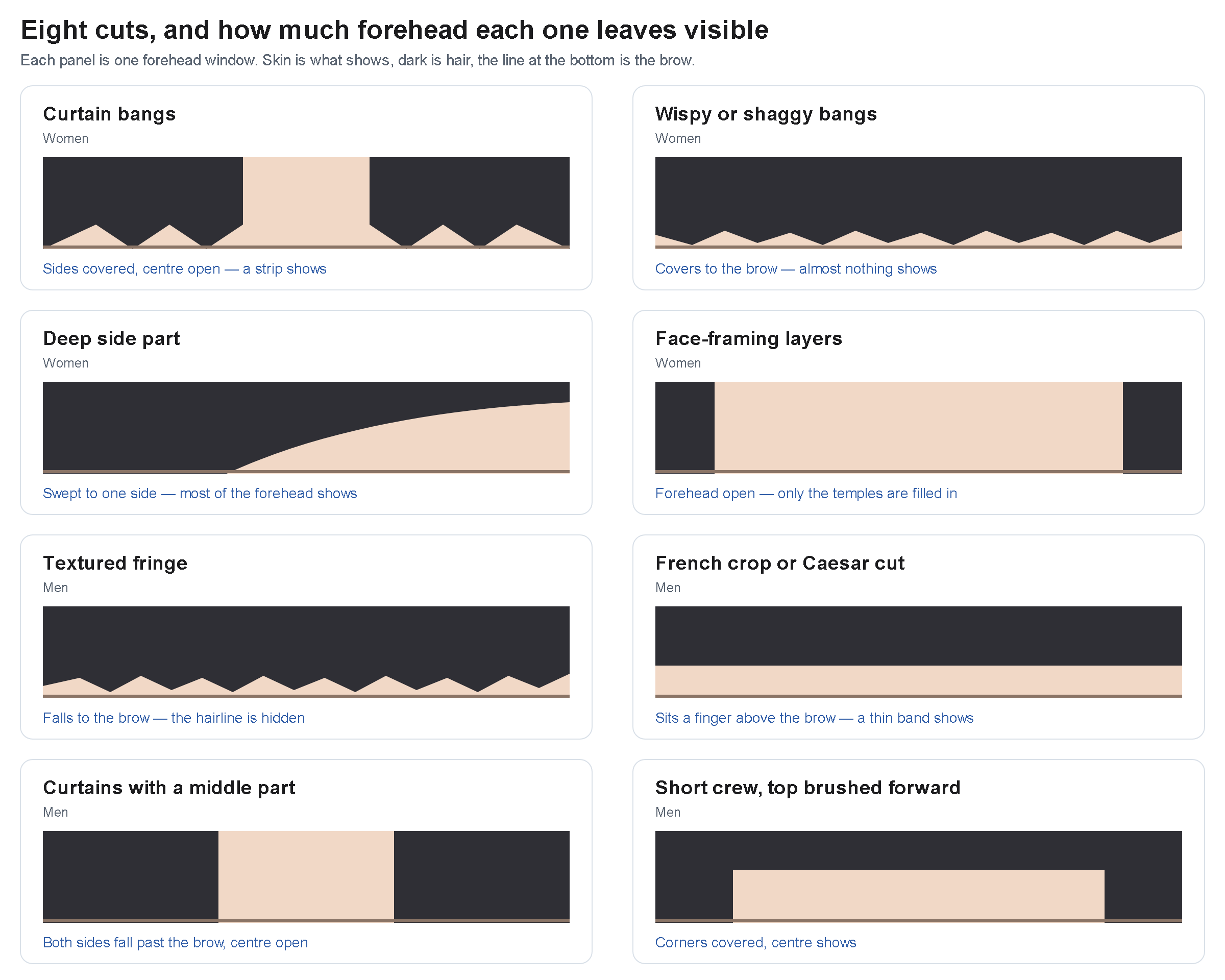
Women. Curtain bangs split the forehead down the middle and leave the centre open. Wispy or shaggy bangs cover the hairline without adding weight. A deep side part pulls the eye sideways to the cheekbones. Face-framing layers add width at the temples so the forehead reads narrower.
Men. A textured fringe falls forward over the hairline and adds movement. A French crop or Caesar cut sits low near the brow and shortens the face. Curtains with a middle part soften a high hairline from both sides. A short crew with the top brushed forward covers the corners without hiding the scalp.
What follows is the reasoning behind those eight choices, not a replacement for them: what the forehead measurements actually measure, why the numbers differ from one page to another, and what an angle adds that a length cannot.
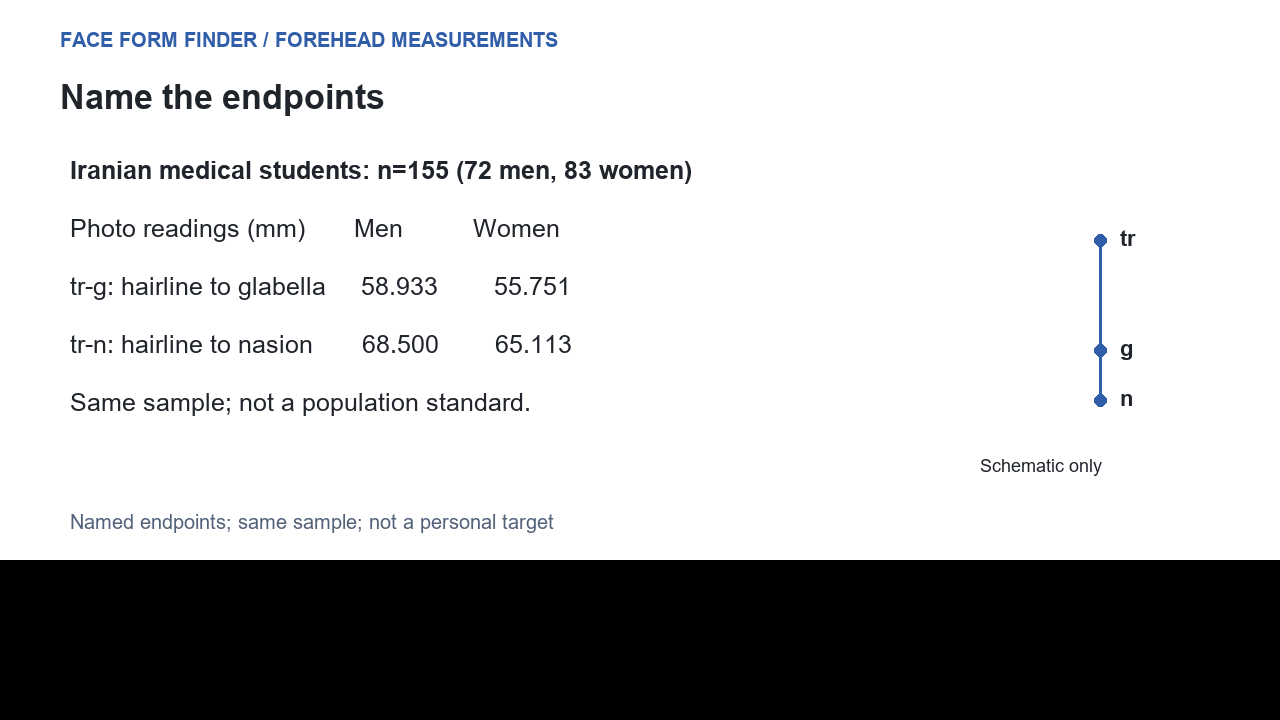
Name the endpoints
The trichion (tr) is the midpoint of the hairline. The glabella (g) is the most prominent midline point between the eyebrows; the nasion (n) is the midpoint of the nasofrontal suture. The Iranian sample comprises 155 medical students, 72 men and 83 women, selected with specified dental and medical exclusions. These are sample summaries, not population standards.
The operators used frontal and lateral photographs in natural head position, a camera distance of 2 metres and a 1 cm scale. A single operator read images in AutoCAD 2008. These are recorded vertical lines; they are not measurements of a tape following the skin contour.
| Reading | Men mean | Women mean | Reported dispersion, men / women |
|---|---|---|---|
| tr–g | 58.933 | 55.751 | 6.1150 / 6.9009 |
| tr–n | 68.500 | 65.113 | 5.7529 / 7.2194 |
Dispersion is labelled “SD(SEM)”, while the method description uses SD. That wording is ambiguous; the values above are not relabelled as standard errors, confidence intervals or individual normal ranges.
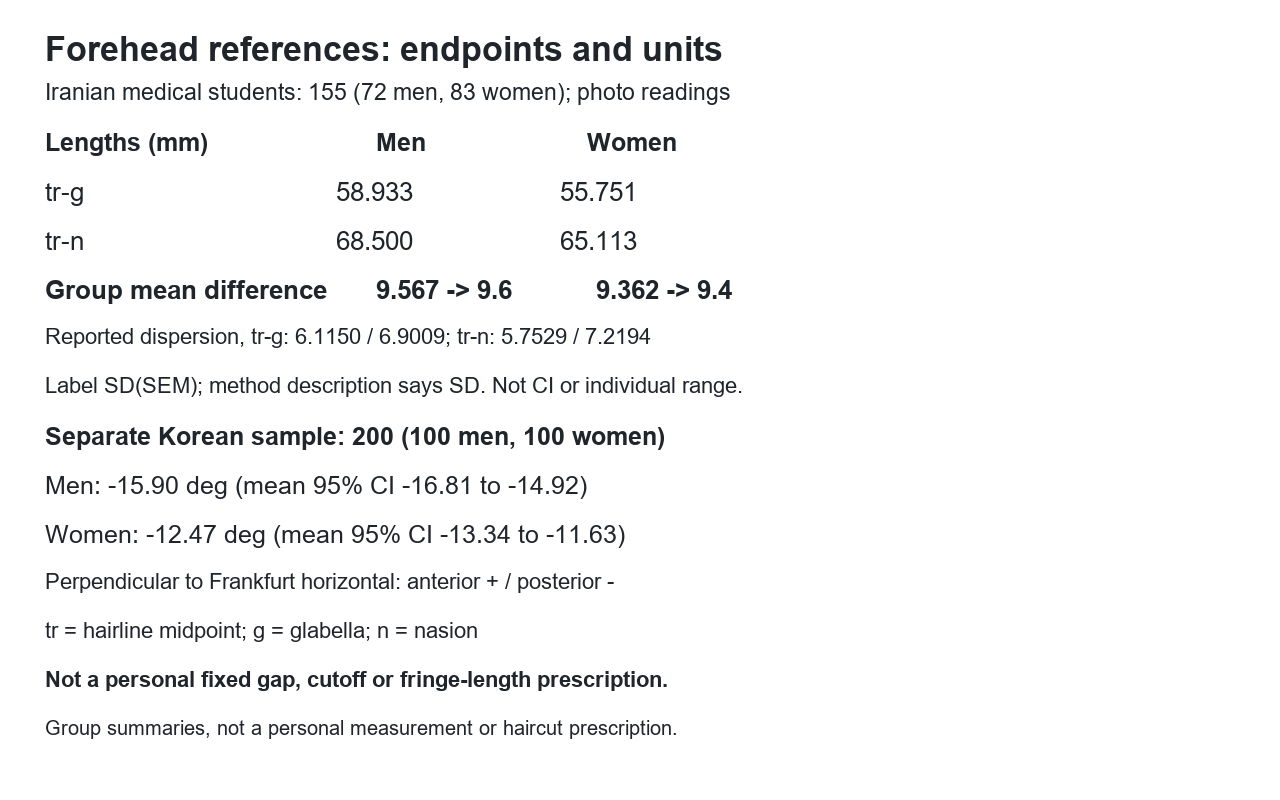
Calculated from the same table, tr–n minus tr–g is 68.500 − 58.933 = 9.567 mm for men (9.6 mm rounded) and 65.113 − 55.751 = 9.362 mm for women (9.4 mm rounded). Subtracting the rounded display values instead, 65.1 − 55.8, gives 9.3, which is not the original-precision figure. Neither difference is a fixed gap on an individual forehead or a length of hair to remove.
The side view is a separate sample
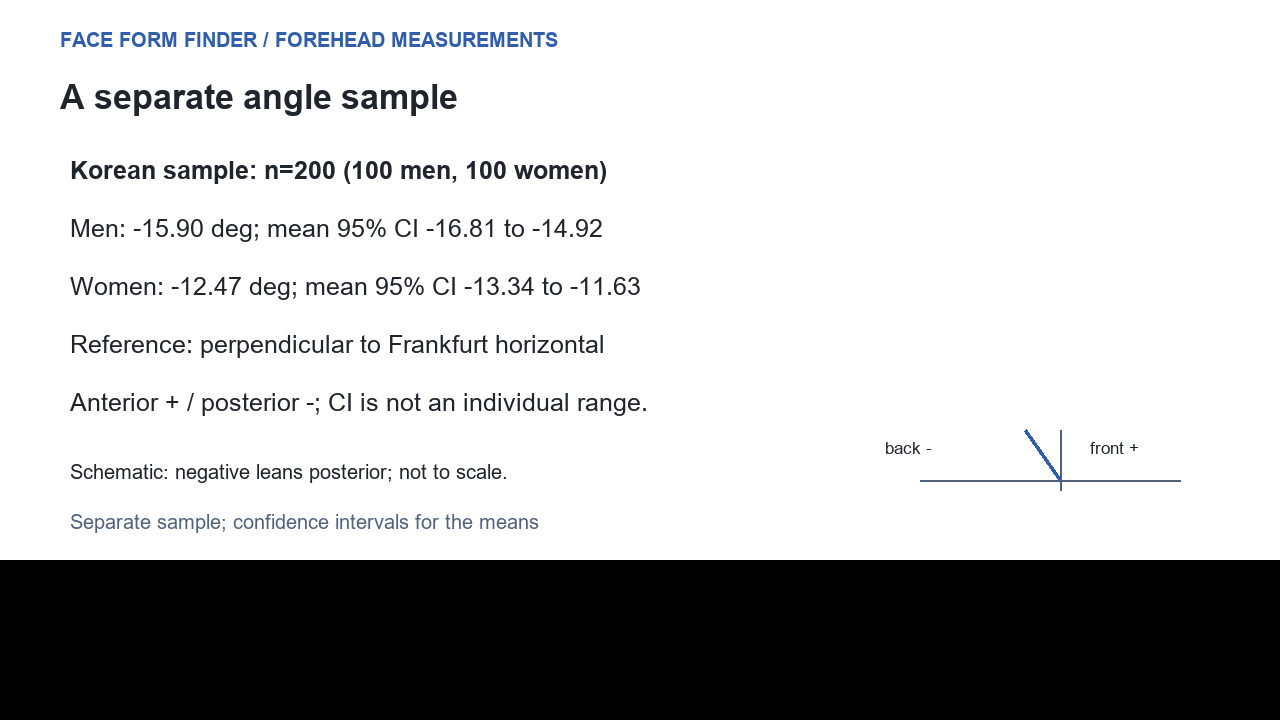
The separate Korean sample contains 200 participants, 100 men and 100 women. It measured the trichion–glabella line against a line perpendicular to the Frankfurt horizontal line. The perpendicular is zero degrees: anterior inclination is positive, posterior inclination negative. The method description mentions a goniometer, direct measurements and lateral photographs; these descriptions do not establish a photographic protocol identical to the Iranian measurements. The recorded age wording and decade groups do not provide a consistent precise upper-age boundary.
| Group | n | Mean | 95% confidence interval for mean |
|---|---|---|---|
| Men | 100 | −15.90° | −16.81° to −14.92° |
| Women | 100 | −12.47° | −13.34° to −11.63° |
A confidence interval for a mean is not an individual range or SD. The two samples cannot establish a relationship between height and inclination by combining their averages. Degrees cannot be converted into fringe length.
Discuss preferences, rather than prescribe from a mean
Haircut outcomes were not tested in these samples. You can discuss how much forehead you prefer visible, how your hair naturally falls, and how much styling you want to do. These are conversation options, not a validated ranking. You may ask to discuss the appearance of your usual dry styling before agreeing a front length; these measurements do not establish a universal wet-to-dry correction or prove that a shorter fringe requires more frequent trimming.
| Topic | What to record |
|---|---|
| Visible forehead | Your preferred appearance, without a validated cutoff |
| Hair behaviour | Your usual parting and styling; discuss observations with your stylist |
| Maintenance | Time and visits you are willing to consider; no promised interval |
| Any measurement | Endpoints, method and unit; not a diagnosis or a fringe-length prescription |
Original precision, calculated differences and separately labelled confidence intervals.
The two readings on one card
Questions
What counts as a big forehead?
These measurements do not validate a universal boundary. A sample mean does not classify an individual.
Does a big forehead mean a receding hairline?
A single measurement cannot establish hairline change or its cause. A single reading does not provide a diagnostic rule for that question.
Can a haircut make a forehead smaller?
Styling may change its visible coverage. Perceived size and haircut outcomes were not tested in these samples.
Which haircut should I choose?
These measurements do not select one. Discuss your preferred appearance, hair behaviour and maintenance with a stylist.
Related guides
- Receding Hairline Haircuts for Men — the same band read as a change over time, and the fringe length that returns it.
- Hairline Shapes — the four contours and the three heights, before the cut is chosen.
- Face Shape Chart — the thirds of the face, and how to check them at home.
- Midface Ratio — what happens to a reading when the same face is measured to two different end points.
- Haircuts for Men — the family list, once the front length is decided.
- Hair Length Chart — length tiers with inches and centimetres side by side.
The 143-second version
Named endpoints, calculated differences and a separate angle sample.
If the player does not load, watch the 2:23 version on YouTube: Haircut for a Big Forehead: The Band, Read Two Ways.
Measurements do not select a haircut: the figures above describe group samples, not what any one person should wear.